
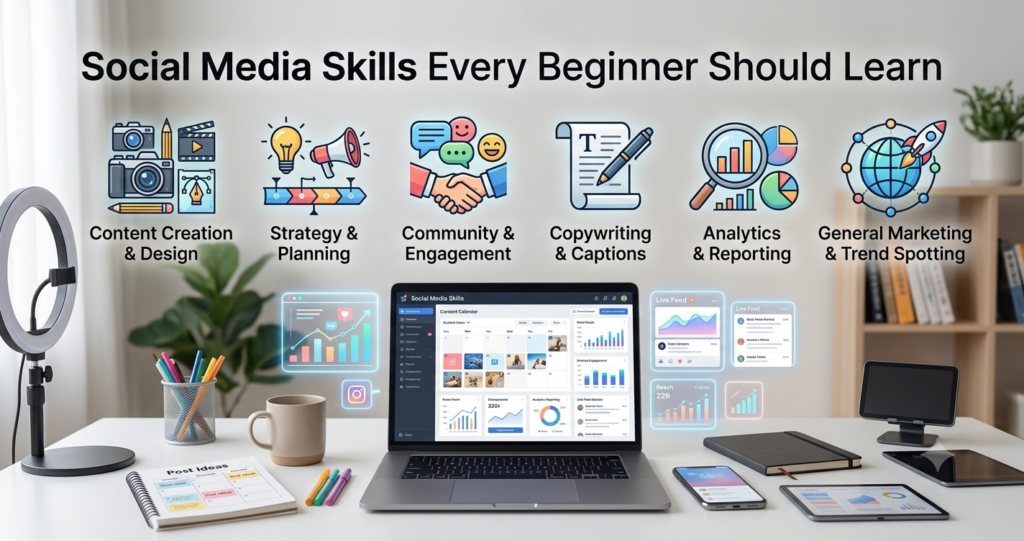
Social media has become an essential part of digital marketing, personal branding, business growth, and online communication. Whether someone wants to work as a social media manager, content creator, digital marketer, freelancer, or business owner, developing the right social media skills can create valuable career opportunities. Beginners do not need to master every platform immediately; instead, they should build a strong foundation in strategy, content, communication, analytics, and audience engagement.
Understanding the Social Media Skills Every Beginner Should Learn is especially important because successful social media marketing involves much more than simply publishing posts. Professionals need to understand their target audience, create useful content, maintain a consistent brand voice, analyse performance, and adapt strategies according to changing trends. With regular practice, beginners can gradually develop the confidence and practical knowledge needed to manage social media effectively.
What Social Media Skills Should Every Beginner Learn?
Beginners should focus on a combination of creative, analytical, communication, and strategic abilities. These skills help social media professionals create meaningful content while also understanding how audiences interact with different platforms. Building these fundamentals first makes it easier to progress towards advanced areas such as paid advertising, influencer marketing, and social media campaign management.
The Social Media Skills Every Beginner Should Learn should not be viewed as isolated technical abilities. Most of them work together as part of a complete social media strategy. For example, content creation becomes more effective when combined with audience research, while analytics becomes useful when marketers understand their campaign objectives and key performance indicators.
Social Media Skills
- Social Media Strategy: Beginners should learn how to create a basic social media strategy based on business objectives, audience needs, platforms, content types, and measurable goals.
- Content Creation: Creating engaging social media content is one of the most important beginner skills. Professionals should understand how to develop captions, images, short-form videos, carousels, stories, and other formats that communicate ideas clearly.
- Audience Research: Understanding the target audience helps beginners create content that addresses real interests, questions, problems, and preferences.
- Copywriting: Strong social media copywriting helps turn ordinary information into persuasive and engaging messages. Beginners should practise writing concise captions, attention-grabbing hooks, calls to action, and platform-appropriate promotional content.
- Visual Communication: Social media is highly visual, so beginners should understand basic principles of design, layout, typography, spacing, and visual hierarchy.
- Social Media Analytics: Beginners should learn to interpret metrics such as reach, impressions, engagement rate, clicks, follower growth, and conversions. Analytics helps identify what works and what needs improvement.
How Can Beginners Improve Their Social Media Marketing Skills?
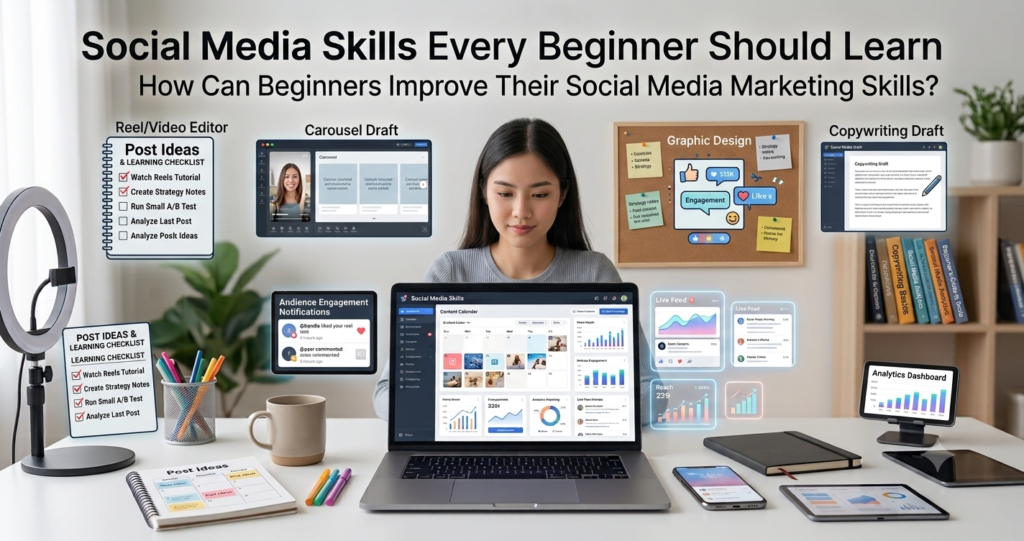
Improving social media marketing skills requires consistent learning and practical application. Reading about social media concepts can provide useful knowledge, but beginners develop much faster when they apply those concepts by creating sample campaigns, managing personal accounts, analysing successful brands, and experimenting with different content formats.
A practical learning approach also helps beginners understand that every platform has different audiences, content styles, and communication expectations. Instead of trying to become an expert on every network at once, beginners can start with one or two relevant platforms and gradually expand their knowledge as their confidence improves.
Key Factors
- Practise Content Planning: Create a simple content calendar containing educational, promotional, entertaining, and engagement-focused posts. Planning content in advance helps maintain consistency and reduces the pressure of finding new ideas every day.
- Study Successful Accounts: Analyse established brands and creators to understand their posting frequency, captions, visual styles, content formats, and audience interactions.
- Learn Platform Features: Spend time exploring features such as Instagram Reels, Stories, LinkedIn posts, Facebook groups, YouTube Shorts, and other relevant formats.
- Experiment With Content Formats: Beginners should test videos, graphics, polls, carousels, text posts, and educational content to discover what generates the strongest response.
- Review Performance Regularly: Set aside time each week or month to examine social media analytics. Compare posts based on reach, engagement, clicks, saves, shares, and other relevant metrics to identify successful content patterns.
- Keep Learning: Social platforms continuously introduce new features, algorithms, advertising options, and content trends. Following reliable industry resources and practicing new techniques helps beginners.
Why Is Content Creation an Important Social Media Skill?
Content creation is at the centre of most successful social media strategies because audiences need a reason to stop scrolling, consume information, and interact with a post. Effective content should provide value while matching the platform, audience, brand identity, and campaign objective. Beginners should therefore learn to create content that is useful, relevant, visually appealing, and easy to understand.
Good content creation is not limited to graphic design or writing attractive captions. It involves understanding content ideas, storytelling, visual presentation, audience psychology, trends, and calls to action. Developing this skill allows beginners to transform business information into social media posts that encourage awareness, engagement, trust, or conversion.
Key factors
- Learn Storytelling: Social media storytelling helps brands communicate ideas through relatable experiences, customer examples, educational sequences, and behind-the-scenes content.
- Create Valuable Content: Beginners should focus on content that educates, entertains, inspires, or solves a specific audience problem. Providing consistent value can encourage users to follow an account and return for future content.
- Understand Content Formats: Different messages work better in different formats, such as videos for demonstrations, carousels for step-by-step information, and short posts for quick insights.
- Develop Visual Design Skills: Basic knowledge of Canva or similar design platforms can help beginners produce clean social media graphics. They should pay attention to readability, spacing, consistency, and brand identity.
- Write Strong Captions: Captions should communicate the main idea quickly and encourage the desired action. Beginners can improve by using clear openings, concise explanations, relevant keywords, and natural calls to action.
- Build a Content Calendar: A content calendar organises topics, formats, publishing dates, campaigns, and important events. It also helps ensure that the social media feed contains a balanced mixture of content instead of repetitive promotional posts.
How Can Beginners Build a Strong Social Media Strategy?
A social media strategy provides direction for all social media activities. Without one, businesses may publish frequently but struggle to achieve meaningful results. A beginner-friendly strategy should establish the target audience, marketing objectives, suitable platforms, content pillars, posting approach, engagement methods, and performance indicators.
Strategy development also requires flexibility because audience behaviour and platform algorithms can change. Beginners should treat their initial strategy as a working framework rather than a permanent document. By monitoring results and learning from audience behaviour, they can gradually refine their approach.
- Define Clear Objectives: Start by deciding whether the campaign aims to increase brand awareness, generate leads, drive website traffic, improve engagement, or support sales.
- Identify the Target Audience: Develop a basic understanding of who the content is intended for, including their needs, interests, challenges, preferences, and online behaviour.
- Choose Relevant Platforms: Businesses do not necessarily need to maintain an active presence on every social network. Beginners should select platforms where their target audience is most likely to spend time.
- Create Content Pillars: Content pillars are broad themes that guide regular content production. Examples include education, industry insights, product information, customer stories, and behind-the-scenes content.
- Establish a Posting Schedule: Consistency is more useful than publishing large amounts of content irregularly. A realistic schedule allows beginners to maintain quality while developing a sustainable social media presence.
- Measure Key Performance Indicators: Select metrics that relate directly to the campaign objective. Tracking relevant KPIs allows marketers to understand whether their strategy is producing meaningful progress.
What Communication Skills Are Needed for Social Media Management?
Communication is one of the most valuable skills for anyone working in social media management. Social media professionals communicate with customers, followers, clients, colleagues, influencers, and online communities every day. Their communication style can directly influence how people perceive a brand and its level of professionalism.
Effective communication also involves listening rather than simply publishing promotional messages. Beginners should learn how to respond politely to questions, acknowledge feedback, handle criticism, and maintain a consistent brand voice. Good communication builds stronger relationships and can turn casual followers into loyal customers.
Communication Skills for Social Media Management
- Active Listening: Beginners should monitor comments, questions, mentions, and conversations related to the brand. Listening carefully helps identify customer concerns, content opportunities, and changes in audience expectations.
- Community Engagement: Social media management involves building relationships rather than simply collecting followers. Responding to comments and encouraging meaningful conversations can help create a stronger online community.
- Professional Writing: Clear grammar, appropriate vocabulary, and concise communication are important for maintaining credibility. Beginners should adapt their writing style to the platform while preserving the brand’s personality.
- Customer Service: Social media often functions as a customer-support channel. Professionals should learn how to respond calmly and helpfully, particularly when users report problems or ask detailed questions.
- Crisis Communication: Negative comments or public complaints can sometimes become highly visible. Beginners should understand the importance of staying professional, avoiding emotional responses, and escalating serious issues.
- Brand Voice: A consistent brand voice makes communication recognisable across different platforms. Beginners should learn whether a brand should sound professional, friendly, educational, conversational, or authoritative.
How Important Are Social Media Analytics for Beginners?
Social media analytics allows marketers to move beyond assumptions and make decisions using performance data. Metrics provide information about how audiences interact with content and whether campaigns are moving towards their objectives. Beginners who learn analytics early can improve their strategies much more effectively than those who rely only on intuition.
Analytics does not mean that beginners need advanced data science knowledge. They should first understand the meaning of common metrics and learn how to compare performance over time. The ability to identify successful content, recognise weak performance, and make practical recommendations is an important professional skill.
Key Factors
- Reach and Impressions: Reach shows how many individual users were exposed to content, while impressions indicate how often content was displayed. Understanding the difference helps beginners evaluate visibility and distribution.
- Engagement Rate: Engagement rate considers interactions such as likes, comments, shares, and saves relative to an account’s audience or content reach. It can provide a better understanding of audience response than follower counts alone.
- Click-Through Rate: CTR indicates how effectively content encourages users to click a link or call to action. It is particularly useful when social media posts are designed to generate website visits or leads.
- Follower Growth: Tracking follower growth can provide insight into whether an account is attracting new audiences. However, beginners should consider follower quality and engagement rather than treating follower count as the only measure of success.
- Conversion Tracking: Conversions represent valuable actions such as form submissions, purchases, registrations, or enquiries. Understanding conversions helps connect social media activity with broader business outcomes.
- Performance Reporting: Beginners should learn to create simple reports summarising goals, important metrics, successful content, weak areas, and recommended improvements.
Which Social Media Tools Should Beginners Learn?
Social media professionals use various tools to create, schedule, analyse, and manage content. Beginners do not need to learn dozens of platforms at once. It is better to become comfortable with a small selection of useful tools and understand how each one supports a specific part of the workflow.
Learning tools can also improve productivity. Instead of manually performing every task, beginners can use scheduling platforms, design software, analytics dashboards, and content-planning systems to organise their work. Tool knowledge therefore complements rather than replaces fundamental social media skills.
Social Media Tools for Beginners Learn
- Canva: Canva is useful for creating social media graphics, presentations, carousels, banners, and other visual assets. Beginners can use templates while gradually learning fundamental design principles.
- Meta Business Suite: This platform can help users manage content and interactions across Meta’s supported platforms. Learning its publishing and performance features can be valuable for beginners working with Facebook and Instagram.
- Scheduling Tools: Social media scheduling tools allow professionals to prepare and organise posts in advance. Scheduling can improve consistency and make content management more efficient.
- Analytics Platforms: Beginners should become familiar with native platform analytics and basic reporting dashboards. These tools provide valuable information about audience behaviour and content performance.
- Keyword and Trend Research Tools: Understanding trending topics and relevant search terms can help beginners discover content opportunities. Research should always remain relevant to the audience and brand.
- Project Management Tools: Platforms used for task management can organise content ideas, approvals, deadlines, creative assets, and publishing schedules. Strong organisation becomes particularly important when managing multiple accounts or clients.
How Can Beginners Build a Career Using Social Media Skills?
Social media skills can support several career paths, including social media management, digital marketing, content creation, community management, influencer marketing, and freelance marketing services. Beginners can start by building practical experience through personal projects, sample campaigns, internships, volunteer work, or small freelance assignments.
A strong portfolio can be more useful than simply listing social media skills on a CV. Beginners can demonstrate their abilities by creating sample content calendars, mock campaigns, social media audits, analytics reports, captions, and visual posts. These examples show potential employers or clients how the candidate thinks and works.
- Build a Portfolio: Create sample social media campaigns for imaginary or publicly available brands without misrepresenting the work as client work. Include strategy, content examples, captions, visual concepts, and performance goals.
- Develop a Personal Brand: Maintaining a professional online presence can demonstrate your own social media abilities. Share useful insights, industry observations, content experiments, and examples of your work consistently.
- Offer Freelance Services: Beginners can start with manageable services such as content creation, caption writing, scheduling, community management, or basic social media audits.
- Learn Paid Advertising: Once organic social media fundamentals are strong, beginners can explore paid social advertising. Understanding targeting, budgets, creatives, campaign objectives, and performance metrics can expand career opportunities.
- Study Social Media Trends: Following industry developments helps professionals understand changing content formats, platform behaviour, creator trends, and audience expectations.
- Keep Improving: Social media marketing changes continuously, so professional growth requires ongoing practice. Beginners should regularly review their results, learn from mistakes, update their skills, and experiment with new approaches.
Conclusion
Learning the Social Media Skills Every Beginner Should Learn provides a practical foundation for entering digital marketing and building a professional online presence. Content creation, audience research, copywriting, communication, social media strategy, community engagement, analytics, and basic tool knowledge all contribute to effective social media management. Beginners should focus on developing these skills through consistent practice rather than attempting to master every platform or advanced technique immediately.
The strongest social media professionals combine creativity with strategy and data-driven decision-making. By creating a portfolio, experimenting with different content formats, studying audience behaviour, monitoring analytics, and continuously improving their knowledge, beginners can turn foundational social media skills into valuable professional capabilities. With patience and practical experience, these skills can support careers in freelance work, content marketing, social media management, and broader digital marketing roles.
Explore Our Recent Blog
- Technical SEO Basics Every SEO Beginner Should Know
- What Is Digital Marketing, and How Does It Work?
Frequently Asked Questions
1. What are the most important social media skills for beginners?
The most important skills include content creation, social media strategy, audience research, copywriting, communication, community management, and analytics. Beginners should also develop basic visual design and organisational skills. These abilities create a strong foundation for more advanced social media marketing work.
2. How long does it take to learn social media marketing skills?
The basic concepts can be learned relatively quickly, but becoming proficient requires regular practice and real-world experience. A beginner can build foundational knowledge within a few weeks and improve significantly through several months of consistent application. The learning process should continue because social media platforms and marketing practices constantly evolve.
3. Do beginners need to know graphic design for social media?
Beginners do not need to become professional graphic designers, but basic visual design knowledge is extremely useful. Understanding typography, spacing, composition, colours, image selection, and readability can improve social media content considerably. Tools such as Canva can make it easier to apply these principles without advanced design software.
4. Is social media analytics difficult for beginners?
Social media analytics is not necessarily difficult when beginners start with fundamental metrics. They can first learn reach, impressions, engagement, clicks, follower growth, and conversions before moving into more advanced analysis. The most important skill is understanding what the numbers mean and using them to make better content and strategy decisions.
5. Which platform should a beginner learn first?
The best platform depends on the target audience and professional objective. Beginners can choose one or two platforms that are relevant to their intended industry and learn their content formats, audience behaviour, analytics, and publishing features thoroughly. Building depth on relevant platforms is generally more useful than having superficial knowledge of many networks.
6. Can social media skills help beginners get freelance work?
Yes, social media skills can create opportunities in freelance content creation, social media management, community management, copywriting, and digital marketing. Beginners should build a portfolio containing practical examples before approaching potential clients. Demonstrating strategy, creativity, consistency, and an understanding of analytics can make a beginner’s profile more credible.
