
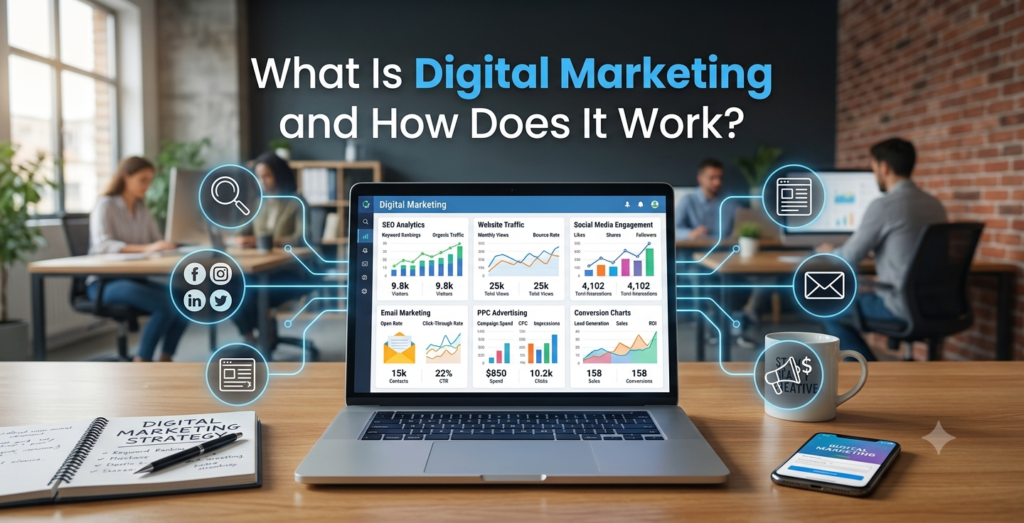
Digital marketing is the process of promoting products, services, or brands through digital channels such as search engines, websites, social media platforms, email, mobile applications, and online advertising networks. Unlike traditional marketing, which often depends on print, television, radio, or outdoor advertising, digital marketing allows businesses to reach specific audiences and measure interactions more precisely. It combines strategy, technology, creativity, data, and customer communication to support business growth.
If you are wondering What Is Digital Marketing and How Does It Work?, the simplest answer is that it connects businesses with potential customers through the digital platforms they already use. A business may attract visitors through search engine optimisation (SEO), engage them through social media marketing, educate them through content marketing, and convert them through paid advertising or email campaigns. These activities work together to move users from awareness to consideration and eventually to conversion.
What Is Digital Marketing, and Why Is It Important for Businesses?
Digital marketing is important because consumers increasingly use digital channels to research products, compare services, read reviews, communicate with brands, and make purchasing decisions. A strong online presence allows a business to remain visible during these moments of consideration. Whether a company operates locally, nationally, or internationally, digital channels can provide opportunities to connect with potential customers at different stages of the buying journey.
Another major advantage is measurability. Businesses can monitor website traffic, search rankings, engagement, leads, conversions, advertising performance, and other key performance indicators (KPIs). This data makes it easier to identify successful campaigns and areas requiring improvement. As a result, digital marketing can become an ongoing optimisation process rather than a one-time promotional activity.
How Does Digital Marketing Differ From Traditional Marketing?
- Marketing Channels: Digital marketing uses websites, search engines, social media, email, and online ads. Traditional marketing uses television, radio, newspapers, magazines, and billboards.
- Audience Targeting: Digital marketing allows precise targeting based on interests, behaviour, location, and demographics. Traditional marketing generally reaches a broader audience with less targeting precision.
- Cost Flexibility: Digital campaigns can start with smaller budgets and be adjusted according to performance. Traditional advertising often requires higher upfront spending for media placement.
- Performance Tracking: Digital marketing provides measurable data such as clicks, traffic, engagement, leads, and conversions. Traditional marketing can be harder to measure accurately at an individual level.
- Customer Interaction: Digital channels allow direct communication through comments, messages, reviews, and emails. Traditional marketing is usually more one-directional with limited immediate interaction.
- Campaign Flexibility: Digital campaigns can be quickly updated, paused, tested, or optimised based on results. Traditional campaigns are generally less flexible after publication or broadcasting.
How Does Digital Marketing Work Step by Step?
The digital marketing process normally follows a sequence that begins with research and ends with measurement and optimisation. First, marketers establish business objectives, define the target audience, research competitors, and understand customer needs. They then choose suitable channels and develop a strategy designed around specific goals such as increasing website traffic, generating leads, improving sales, or building brand awareness.
Once campaigns are launched, marketers analyse how audiences respond to them. Website analytics, search data, social media insights, advertising reports, and conversion information help determine what is working. The strategy can then be refined by improving content, targeting different keywords, changing advertising messages, strengthening landing pages, or adjusting budgets. This cycle makes digital marketing a continuous process rather than a fixed campaign.
What Are the Main Steps in a Digital Marketing Strategy?
- Define Business Goals: Set measurable objectives such as increasing traffic, generating leads, improving sales, or building brand awareness.
- Identify the Target Audience: Understand customer needs, interests, search behaviour, and preferences. This helps create relevant and targeted marketing campaigns.
- Choose Digital Channels: Select suitable channels such as SEO, social media, email marketing, content marketing, and paid advertising.
- Create Valuable Content: Develop useful blogs, videos, guides, graphics, and website content. Valuable content helps attract audiences and build trust.
- Launch and Monitor Campaigns: Publish campaigns and track important performance metrics regularly. Monitoring helps identify what is working and what needs improvement.
- Measure and Optimise: Analyse campaign results and make data-driven improvements. Continuous testing and optimisation can improve overall marketing performance.
What Are the Main Types of Digital Marketing?
Digital marketing includes several disciplines that can be used individually or as part of an integrated strategy. Search engine optimisation helps websites improve their organic visibility, while paid search advertising can provide immediate exposure for selected queries. Social media marketing helps brands communicate with audiences, while content marketing focuses on providing useful information that attracts and nurtures potential customers.
Other important areas include email marketing, affiliate marketing, influencer marketing, mobile marketing, online public relations, and conversion rate optimisation. The most appropriate combination depends on the company’s industry, audience, objectives, resources, and customer journey. A B2B technology company, for example, may rely heavily on SEO, LinkedIn, webinars, and lead nurturing, whereas an e-commerce business may combine SEO, social media, shopping advertisements, email, and remarketing.
Which Digital Marketing Channels Should a Business Use?
- Search Engine Optimisation (SEO): SEO helps websites appear higher in unpaid search results through keywords, quality content, technical optimisation, and internal linking.
- Search Engine Marketing (SEM): SEM uses paid search campaigns to display advertisements to users searching for relevant products, services, or keywords.
- Social Media Marketing: Social media marketing uses platforms such as Facebook, Instagram, and LinkedIn to promote content, engage audiences, and build brand awareness.
- Content Marketing: Content marketing uses valuable blogs, videos, guides, infographics, and other resources to attract, educate, and engage potential customers.
- Email Marketing: Email marketing helps businesses communicate directly with subscribers through newsletters, promotional emails, educational content, and follow-up campaigns.
- Pay-Per-Click Advertising: PPC advertising allows businesses to display targeted advertisements and pay when users click on them, helping generate relevant traffic and potential leads.
How Does SEO Fit Into Digital Marketing?
SEO is one of the most important components of digital marketing because search engines can introduce businesses to users who are actively looking for information, products, or services. A well-optimised website can attract relevant organic traffic without paying for every individual click. SEO typically involves keyword research, on-page optimisation, technical SEO, content development, internal linking, and authority-building strategies.
SEO also supports long-term visibility. While paid advertising can produce traffic while a campaign is funded, organic search visibility can continue generating visits when a website consistently provides useful content and maintains strong technical foundations. However, SEO requires patience because rankings can take time to develop and depend on competition, content quality, website authority, search intent, and many other factors.
Why Is Content Important for SEO and Digital Marketing?
- Improves Search Visibility: Quality content helps search engines understand a website and its topics. Relevant content can improve organic rankings for valuable searches.
- Attracts Target Audiences: Useful content answers customer questions and addresses their needs. This helps businesses attract relevant and interested visitors.
- Builds Brand Authority: Informative blogs, guides, and case studies demonstrate expertise. Consistent valuable content can strengthen credibility and customer trust.
- Supports Keyword Strategy: Content provides natural opportunities to use relevant primary and secondary keywords. Proper keyword usage helps search engines understand content relevance.
- Generates Leads and Conversions: Helpful content can guide visitors towards enquiries, purchases, or other actions. Clear calls to action can turn interested visitors into leads.
- Supports Long-Term Growth: Evergreen content can continue attracting organic traffic over time. Regular updates help businesses maintain relevance and usefulness.
How Does Social Media Marketing Work?
Social media marketing works by using social platforms to distribute content, communicate with audiences, encourage engagement, and strengthen brand relationships. Businesses can publish educational posts, product demonstrations, customer stories, videos, graphics, polls, and other content formats according to platform behaviour. Social media can also provide a direct communication channel through comments, messages, and community interactions.
Paid social advertising extends this process by allowing businesses to promote content or offers to selected audience segments. Marketers can evaluate impressions, reach, engagement, clicks, leads, conversions, and other performance indicators. However, social media success should not be judged only by follower numbers; meaningful engagement, qualified traffic, customer relationships, and business outcomes are often more important.
How Can Businesses Create an Effective Social Media Strategy?
- Set Platform-Specific Goals: Define objectives such as brand awareness, website traffic, engagement, lead generation, or customer support. Each platform can serve a different purpose based on business goals.
- Develop Audience Personas: Understand the target audience, including their interests, needs, preferences, and online behaviour. These insights help create relevant content and effective messaging.
- Create Consistent Content: Maintain a regular publishing schedule with educational, promotional, visual, and interactive content. Consistency helps audiences recognise the brand and remain engaged.
- Encourage Engagement: Respond to comments and messages, ask questions, conduct polls, and join relevant conversations. Two-way communication helps build stronger relationships with social media audiences.
- Use Paid Promotion Strategically: Promote high-performing content or run targeted advertising campaigns to reach selected audiences. Paid promotion can extend reach and attract potential customers.
- Measure Meaningful Results: Track engagement, clicks, leads, conversions, and referral traffic to evaluate performance. These insights help improve future social media campaigns.
How Do Paid Advertising and PPC Campaigns Work?
Paid digital advertising allows businesses to purchase visibility across search engines, social platforms, websites, applications, and other digital environments. PPC campaigns commonly charge advertisers when users click an advertisement, although other pricing models can also be used depending on the platform and campaign objective. Advertisers typically select audiences, keywords, locations, budgets, messages, creative assets, and landing pages.
The effectiveness of paid advertising depends on more than simply increasing the budget. Relevant targeting, persuasive advertisements, appropriate keyword selection, strong landing pages, and accurate conversion tracking all influence performance. Marketers should continually analyse metrics such as click-through rate (CTR), cost per click (CPC), conversion rate, cost per acquisition (CPA), and return on advertising spend (ROAS).
What Is the Role of Conversion Rate Optimisation?
Conversion rate optimisation (CRO) focuses on improving the percentage of website visitors who complete a desired action. This action could involve purchasing a product, submitting a form, booking a consultation, signing up for a newsletter, or requesting additional information. CRO examines elements such as page layout, headlines, calls to action, forms, trust signals, navigation, and user experience.
CRO is valuable because increasing conversions does not always require increasing traffic. If a website receives 10,000 visitors but converts poorly, improving the user journey may generate more leads or sales from the same traffic volume. Businesses can use analytics, user behaviour data, testing, and landing-page improvements to identify opportunities for better conversion performance.
How Can Businesses Measure Digital Marketing Success?
Measuring digital marketing success requires connecting marketing activities with meaningful business outcomes. Traffic and engagement metrics can provide useful information, but businesses should also examine leads, sales, customer acquisition costs, conversion rates, revenue, and return on investment (ROI). The right metrics depend on the campaign’s objective and the stage of the customer journey.
For example, an awareness campaign may focus on reach, impressions, video views, and brand engagement, while a lead-generation campaign may prioritise qualified leads and cost per lead. E-commerce businesses may concentrate on transactions, revenue, average order value, conversion rate, and ROAS. By connecting channel-specific metrics with broader business goals, companies can make better investment decisions.
Which Digital Marketing Metrics Should Be Tracked?
- Organic Traffic: Measures visits generated through unpaid search results. Increasing qualified organic traffic can indicate that SEO and content strategies are reaching relevant users.
- Conversion Rate: Shows the percentage of users completing a desired action. It helps businesses evaluate how effectively websites and landing pages turn visitors into leads or customers.
- Cost Per Lead: Indicates how much a business spends to generate a lead through a campaign. Lower costs can be positive, but lead quality should also be considered.
- Customer Acquisition Cost: Estimates the cost associated with acquiring a new customer. Comparing acquisition cost with customer value helps businesses assess marketing efficiency.
- Return on Investment: ROI connects marketing expenditure with financial returns. It provides a broader view of whether marketing activities are contributing economically to the business.
- Customer Lifetime Value: CLV estimates the value a customer can generate throughout the relationship with a company. It is particularly useful when evaluating acquisition strategies and retention efforts.
What Are the Benefits of Digital Marketing for Small Businesses?
Digital marketing can help small businesses compete for attention without necessarily requiring the large budgets traditionally associated with mass-media advertising. Local SEO, content marketing, social media, email campaigns, and targeted advertising can help smaller organisations reach specific audiences. Businesses can also start with selected channels and expand as their results and resources grow.
Another advantage is the ability to build direct relationships with customers. A useful blog can answer questions before a customer contacts the business, while social media can support ongoing communication and email can encourage repeat purchases. When these activities are supported by accurate analytics and a clear strategy, small businesses can gradually develop stronger online visibility and customer loyalty.
What Mistakes Should Businesses Avoid in Digital Marketing?
- Ignoring the Target Audience: Generic messaging may fail to address the real problems, motivations, and expectations of potential customers. Audience research should guide content and campaign decisions.
- Using Keywords Unnaturally: Excessive keyword repetition can make content difficult to read and may weaken its usefulness. Keywords should be incorporated naturally around relevant search intent.
- Neglecting Mobile Users: Many users access websites through smartphones. Poor mobile usability can create friction and negatively affect engagement and conversions.
- Failing to Track Conversions: Traffic alone does not demonstrate business success. Proper conversion tracking helps identify which channels are actually contributing to valuable actions.
- Expecting Instant SEO Results: Organic search visibility usually requires consistent work and time. Businesses should evaluate progress over realistic periods instead of abandoning SEO prematurely.
- Not Updating the Strategy: Customer behaviour, technology, competitors, and digital platforms change continuously. Successful marketers review performance regularly and adapt their strategies accordingly.
How Does Digital Marketing Work for the Customer Journey?
Digital marketing can support customers from their first interaction with a brand through research, consideration, purchase, and post-purchase engagement. During the awareness stage, users may discover a business through social media, search results, videos, advertisements, or online recommendations. During consideration, detailed content, reviews, product information, comparison pages, and email communication can help users evaluate their options.
At the conversion stage, well-designed landing pages, clear calls to action, transparent pricing, trust signals, and a smooth checkout or enquiry process can reduce friction. After purchase, email marketing, customer support, loyalty programmes, useful content, and social engagement can encourage retention. This means digital marketing is not limited to attracting new customers; it can also support relationships with existing ones.
How Can Businesses Build an Integrated Digital Marketing Strategy?
- Set Clear Marketing Goals: Define objectives such as increasing traffic, generating leads, improving sales, or building brand awareness. Align all marketing activities with these goals.
- Understand the Target Audience: Research customer needs, interests, preferences, and online behaviour. Use these insights to create relevant campaigns and messaging.
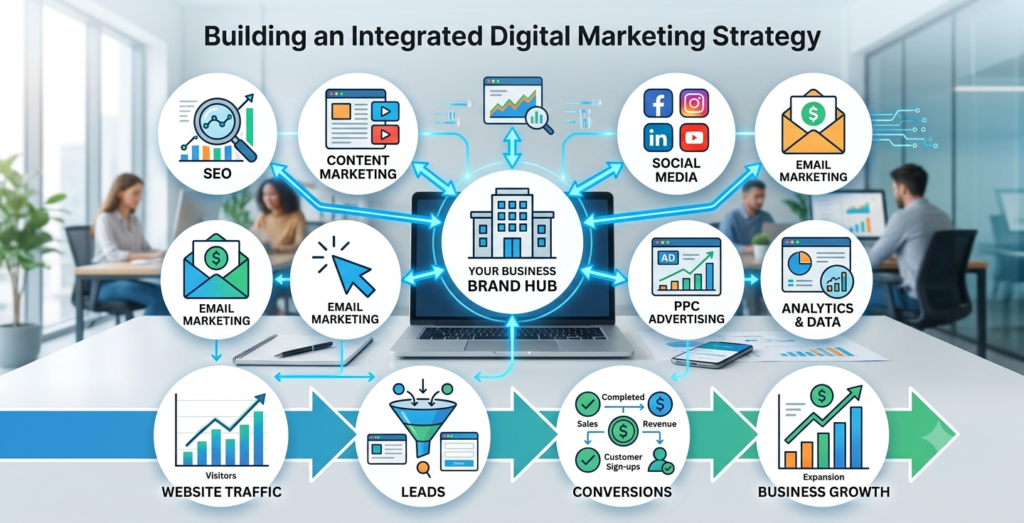
- Connect Different Channels: Combine SEO, content marketing, social media, email marketing, and paid advertising. Make each channel support the others throughout the customer journey.
- Maintain Consistent Messaging: Use a consistent brand voice, visual identity, and key messages across platforms. This creates a recognisable experience and builds customer trust.
- Track Campaign Performance: Monitor traffic, engagement, leads, conversions, and return on investment. Use the data to identify successful channels and improve weak areas.
- Continuously Optimise the Strategy: Review campaign performance regularly and make data-driven improvements. Test different content, channels, and messages to achieve better results.
Conclusion
Understanding What Is Digital Marketing and How Does It Work? provides a strong foundation for businesses and aspiring marketers who want to build a sustainable online presence. Digital marketing brings together SEO, content marketing, social media, email marketing, PPC, analytics, conversion optimisation, and other channels to attract, engage, convert, and retain customers.
The most effective approach is not simply to use as many channels as possible. Instead, businesses should understand their audience, define clear objectives, select appropriate platforms, create valuable experiences, measure meaningful results, and continuously optimise their activities. When these elements work together, digital marketing becomes a measurable and adaptable growth strategy that can support both short-term campaigns and long-term business development.
Explore Our Recent Blog
Frequently Asked Questions
1. What Is Digital Marketing and How Does It Work for Beginners?
Digital marketing is the promotion of products, services, or brands through online channels such as search engines, websites, social media, email, and digital advertising. It works by reaching relevant audiences, providing useful information, encouraging engagement, and guiding potential customers towards a desired action. Beginners should start with clear goals, audience research, and a small number of relevant channels rather than trying to use every digital platform at once.
2. What Are the Main Types of Digital Marketing?
The main types include SEO, search engine marketing, social media marketing, content marketing, email marketing, PPC advertising, affiliate marketing, influencer marketing, and conversion rate optimisation. Each discipline serves a different purpose within the customer journey. Businesses often combine several methods to create a stronger and more complete digital marketing strategy.
3. Is Digital Marketing Effective for Small Businesses?
Yes, digital marketing can be highly useful for small businesses because it allows them to target specific audiences and monitor campaign performance. Local SEO, social media, content, email marketing, and carefully managed paid campaigns can help smaller businesses increase visibility and generate enquiries. Success depends on choosing suitable channels and consistently measuring results rather than simply spending more money.
4. How Long Does It Take to See Results From Digital Marketing?
The timeframe varies according to the channel, competition, budget, website quality, audience, and campaign objectives. Paid advertising can produce visibility and traffic relatively quickly, while SEO and content marketing often require longer-term consistency. Businesses should establish realistic KPIs and evaluate progress over time instead of expecting every digital marketing activity to produce immediate results.
5. What Skills Are Needed for a Digital Marketing Career?
Digital marketers benefit from skills in SEO, content creation, analytics, social media, paid advertising, communication, research, and strategic thinking. Technical knowledge can be useful for areas such as website analytics, tracking, conversion optimisation, and marketing technology. Strong adaptability is equally important because digital platforms, algorithms, consumer behaviour, and marketing practices continue to evolve.
6. How Can I Start a Digital Marketing Strategy for My Business?
Start by defining a measurable business goal and identifying the audience you want to reach. Research customer needs and competitors, select the most relevant digital channels, create useful content, and establish a method for tracking traffic, leads, conversions, and revenue. Review the results regularly and improve the strategy based on evidence rather than assumption
