A social media course can open the door to several entry-level and growth-oriented careers in digital marketing. As businesses increasingly depend on platforms such as Instagram, Facebook, LinkedIn, YouTube, and X to reach customers, they need professionals who can create content, manage communities, analyse performance, and support paid campaigns. Learning social media marketing therefore gives beginners a practical foundation for entering the broader digital marketing industry.
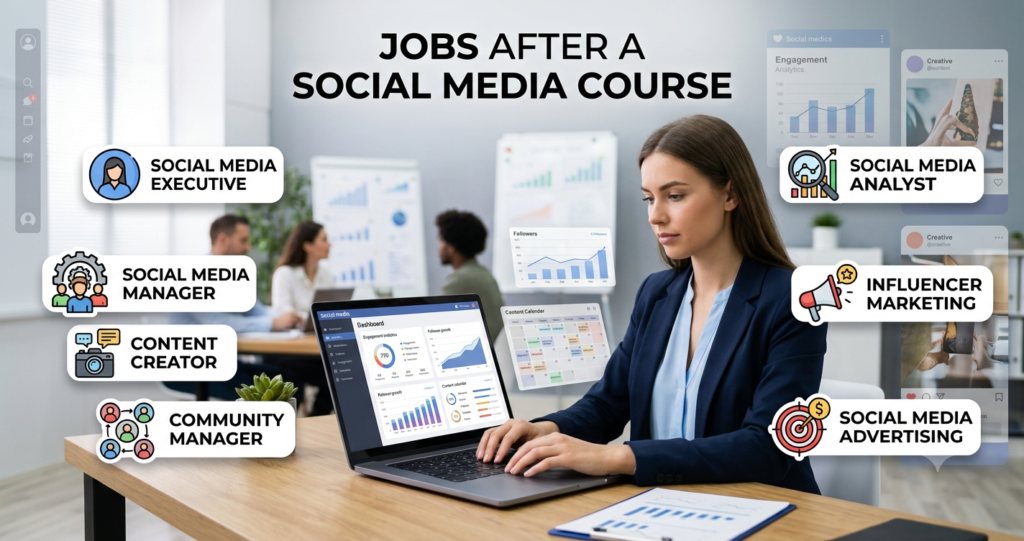
If you are wondering what jobs can you get after a social media course, the answer depends on the skills you develop during your training. Some learners begin as Social Media Executives or Social Media Coordinators, while others move into content creation, community management, influencer marketing, social media advertising, or social media analytics. With experience, these roles can develop into specialist and managerial positions.
What Jobs Can You Get After a Social Media Course?
One of the biggest advantages of learning social media marketing is the variety of career paths available. You do not necessarily have to follow a single job title throughout your career. Depending on your interests, you can choose creative, analytical, strategic, advertising, or client-facing roles. These positions can be available in digital marketing agencies, e-commerce companies, startups, educational organisations, healthcare businesses, hospitality companies, media organisations, and other industries. Your career options can expand significantly as you build practical experience and demonstrate measurable results.
1. Social Media Executive
A Social Media Executive manages daily social media activities such as creating posts, scheduling content, responding to comments, and tracking engagement. This is one of the most suitable social media marketing jobs for beginners after completing a social media course.
2. Social Media Coordinator
A Social Media Coordinator manages content calendars, campaign schedules, creative materials, and day-to-day platform activities. This entry-level social media career option helps beginners gain practical experience in content planning and campaign coordination.
3. Social Media Manager
A Social Media Manager develops social media strategies to increase brand awareness, engagement, website traffic, and conversions. With experience, this role can become a strong social media career path involving campaign management, analytics, team coordination, and client communication.
4. Social Media Content Creator
A Social Media Content Creator produces engaging posts, reels, videos, graphics, captions, and stories for different social media platforms. This role is ideal for creative beginners who enjoy content creation, storytelling, visual communication, and social media marketing.
5. Community Manager
A Community Manager develops relationships between a brand and its online audience by responding to comments, messages, questions, and feedback. The role is suitable for people with strong communication skills who want to build experience in audience engagement and online community management.
6. Social Media Advertising Specialist
A Social Media Advertising Specialist creates and manages paid campaigns on platforms such as Facebook, Instagram, and LinkedIn. Beginners can develop this career by learning social media advertising, audience targeting, campaign optimisation, budget management, and performance tracking.
7. Influencer Marketing Executive
An Influencer Marketing Executive finds suitable influencers and coordinates collaborations between brands and content creators. This role involves influencer research, campaign coordination, communication, content monitoring, and influencer marketing performance analysis.
8. Social Media Analyst
A Social Media Analyst studies metrics such as reach, impressions, engagement, follower growth, website traffic, and conversions. This career is suitable for analytical learners who enjoy using social media analytics and performance data to improve marketing strategies.
9. Content Marketing Executive
A Content Marketing Executive creates and promotes valuable content that supports a company’s broader marketing objectives. The role can include social media content, blog posts, campaigns, and promotional materials, making it a useful digital marketing career option after a social media course.
10. Freelance Social Media Manager
A Freelance Social Media Manager provides social media services independently to businesses, startups, creators, and organisations. Freelancers can offer social media management, content planning, engagement, analytics, and campaign strategy while working with multiple clients.
Which Entry-Level Social Media Jobs Are Best for Beginners?
For beginners, the most accessible opportunities are generally roles where employers expect foundational knowledge rather than several years of strategic experience. A Social Media Executive, Social Media Coordinator, or Junior Content Creator can be a good starting point because these positions allow you to apply classroom knowledge to real campaigns.
As a beginner, you may be responsible for preparing posts, writing captions, scheduling content, researching hashtags, monitoring comments, creating basic reports, and assisting senior marketers. These responsibilities help you understand how social media works in a professional environment. They also allow you to develop a portfolio that can later support applications for higher-level positions.
Social Media Executive
A Social Media Executive typically handles day-to-day social media activities. The role may involve content scheduling, caption writing, hashtag research, engagement monitoring, competitor research, and performance reporting. This is one of the most suitable roles for someone who has recently completed a social media course. It can help you develop practical knowledge while working under the guidance of experienced marketing professionals.
Social Media Coordinator
A Social Media Coordinator focuses on organising and supporting social media campaigns. You may coordinate with writers, graphic designers, video editors, marketing managers, and clients to ensure that content is published according to the campaign schedule. This position can be particularly useful if you have strong organisational and communication skills. It also provides an opportunity to learn how individual social media posts contribute to larger marketing campaigns.
Junior Content Creator
Creative learners can consider junior content creation roles. These jobs may involve developing Instagram posts, short-form videos, reels, carousels, captions, stories, and promotional content. Knowledge of Canva, basic video editing, copywriting, visual storytelling, and platform trends can give candidates an advantage in these positions.
What Career Options Are Available in Social Media Marketing?
Social media marketing has developed into a broad professional field rather than a single job category. Businesses require different specialists for content, advertising, analytics, strategy, community engagement, and influencer campaigns.
If you enjoy creativity, you could specialise in content creation or social media copywriting. If you prefer numbers and performance measurement, social media analytics may be a better direction. People who enjoy communication can explore community management or influencer marketing, while individuals interested in paid campaigns can specialise in social media advertising.
Content and Creative Careers
Content-focused professionals create material that attracts attention and communicates a brand’s message. Common responsibilities include developing content ideas, writing captions, creating visual posts, preparing videos, and adapting content for different platforms. Strong creative careers require more than knowing how to use social media apps. You should understand content strategy, storytelling, brand voice, audience behaviour, visual communication, and content performance.
Community Management Careers
Community managers focus on conversations between brands and their audiences. They respond to comments and messages, identify customer concerns, encourage discussions, and help maintain a positive brand reputation. This career can be suitable for people with strong interpersonal and communication skills. It can also provide valuable experience in customer behaviour and online reputation management.
Social Media Advertising Careers
Paid social media is another important career area. Advertising specialists create and manage campaigns, define target audiences, monitor budgets, test advertisements, and evaluate campaign performance. Professionals working in this area should understand concepts such as audience targeting, conversion tracking, ad creatives, campaign optimisation, cost per click, click-through rate, and return on advertising spend.
Analytics and Reporting Careers
Social media analysts use data to determine whether campaigns are achieving their objectives. They may examine impressions, engagement, follower growth, website traffic, leads, conversions, and other key performance indicators. This career path is particularly suitable for analytical learners who enjoy finding patterns and converting data into actionable marketing recommendations.
What Skills Do Employers Look for After a Social Media Course?
Completing a course gives you foundational knowledge, but employers generally want evidence that you can apply those skills. Your ability to create and execute a basic social media campaign can therefore be just as important as the certificate you hold.
A strong beginner profile should demonstrate social media management, content creation, copywriting, audience research, social media analytics, campaign planning, and basic paid advertising knowledge. Familiarity with commonly used marketing and design tools can further strengthen your CV.
Content Creation Skills
You should know how to develop content appropriate for different platforms. Instagram may require visually engaging reels and carousels, LinkedIn may require professional educational content, while YouTube depends heavily on video quality, titles, thumbnails, and audience retention. Learning Canva, basic video editing, caption writing, and content repurposing can help you produce a more useful portfolio.
Social Media Strategy
Employers value candidates who understand why content is being created rather than simply knowing how to publish it. You should be able to identify a target audience, establish content pillars, set objectives, create a content calendar, and select suitable platforms. A basic social media strategy should connect content activities with measurable business goals such as awareness, engagement, website traffic, lead generation, or sales.
Analytics and Reporting
Understanding analytics allows you to identify what works and what needs improvement. You should become comfortable interpreting metrics such as reach, impressions, engagement rate, follower growth, clicks, leads, and conversions. You should also be able to present insights clearly rather than simply copying numbers into a report. Employers want to know what the data means and what action should be taken next.
Communication Skills
Social media professionals frequently communicate with clients, customers, colleagues, creators, and online communities. Strong written and verbal communication can therefore make a significant difference to your career development. Clear communication is especially important when explaining campaign ideas, responding to customers, writing captions, handling feedback, or presenting performance reports.
Can You Get a Job in Social Media Without Experience?
Yes, beginners can pursue social media jobs without traditional employment experience, but having evidence of practical ability can significantly strengthen your chances. A certificate demonstrates that you completed training, while a portfolio demonstrates that you can actually apply what you learned. If you do not have professional clients yet, create sample projects.
You could develop a 30-day Instagram content calendar for a fictional brand, create a LinkedIn campaign for a hypothetical company, design sample social media advertisements, or prepare a social media audit for an existing business as a practice exercise. Your portfolio should show the thinking behind your work. Instead of displaying only attractive graphics, explain the target audience, campaign objective, content strategy, platform selection, expected KPI, and reasoning behind your creative decisions.
Build a Practical Portfolio
A beginner portfolio can include sample posts, reels, captions, content calendars, campaign strategies, competitor research, social media audits, and analytics reports. These examples give recruiters something concrete to evaluate. You can create projects around industries you understand or want to work with, such as education, healthcare, fashion, technology, hospitality, fitness, or e-commerce.
Gain Practical Experience
Consider internships, freelance assignments, volunteer projects, or personal brand projects. Even a small project can teach you how to manage deadlines, communicate requirements, revise content, and report results. Practical experience also helps you understand challenges that cannot always be learned from a course, including approval processes, changing client requirements, negative comments, content delays, and campaign adjustments.
Create Your Own Professional Presence
Your own social media profiles can also become part of your portfolio. A well-organised LinkedIn profile or professional Instagram account can demonstrate your ability to create consistent content and communicate a clear personal brand. Sharing useful marketing insights, sample campaigns, content ideas, or case studies can help demonstrate your knowledge to potential employers and clients.
What Is the Salary After a Social Media Course?
Salary after a social media course varies considerably depending on job title, location, employer, experience, skills, industry, and responsibilities. A beginner should not evaluate opportunities based on salary alone because the quality of practical exposure can strongly influence future career growth. An entry-level position may provide experience with content scheduling and engagement, while another role may expose you to paid advertising, analytics, client management, and campaign strategy.
The latter experience can potentially help you qualify for more specialised positions later. As you gain experience, you can move from junior responsibilities to roles such as Social Media Manager, Paid Social Specialist, Social Media Strategist, Influencer Marketing Manager, or Digital Marketing Manager. Professionals with strong results and specialised expertise may also command higher compensation.
Factors That Influence Earning Potential
- Specialisation: Expertise in paid advertising, analytics, influencer marketing, or strategy can help differentiate your profile.
- Experience: Employers generally place greater value on candidates who can demonstrate successful campaigns and measurable outcomes.
- Portfolio: A strong portfolio can help you stand out when competing with candidates who have similar educational qualifications.
- Industry: Certain industries may require specialised marketing knowledge and offer different compensation structures.
- Location and Work Model: Salaries can vary between cities, companies, remote positions, agencies, and international clients.
Is Freelancing a Good Career After a Social Media Course?
Freelancing can be an attractive option for people who want flexibility and are comfortable finding and managing their own clients. A social media freelancer may provide services such as content planning, social media management, caption writing, content creation, community management, or social media advertising.
However, freelancing requires more than marketing knowledge. You also need client communication, proposal writing, time management, pricing, invoicing, project management, and personal branding skills. Building a reliable client base can take time, so beginners should approach freelancing as a gradual career-building process.
Services You Can Offer
You can package your skills into clear services instead of presenting yourself simply as someone who “does social media.” For example, you could offer monthly social media management, content calendar development, Instagram content creation, LinkedIn content writing, or social media audit services. Clear service packages make it easier for potential clients to understand what you provide and what they can expect from your work.
Where Freelancers Find Opportunities
Freelancers can explore professional networks, freelance marketplaces, LinkedIn, business communities, referrals, and direct outreach. A strong portfolio and clear service description can improve your chances of receiving enquiries. You can also approach small businesses that have inconsistent social media activity but may benefit from professional content planning and management.
How Can You Grow Your Career After a Social Media Course?
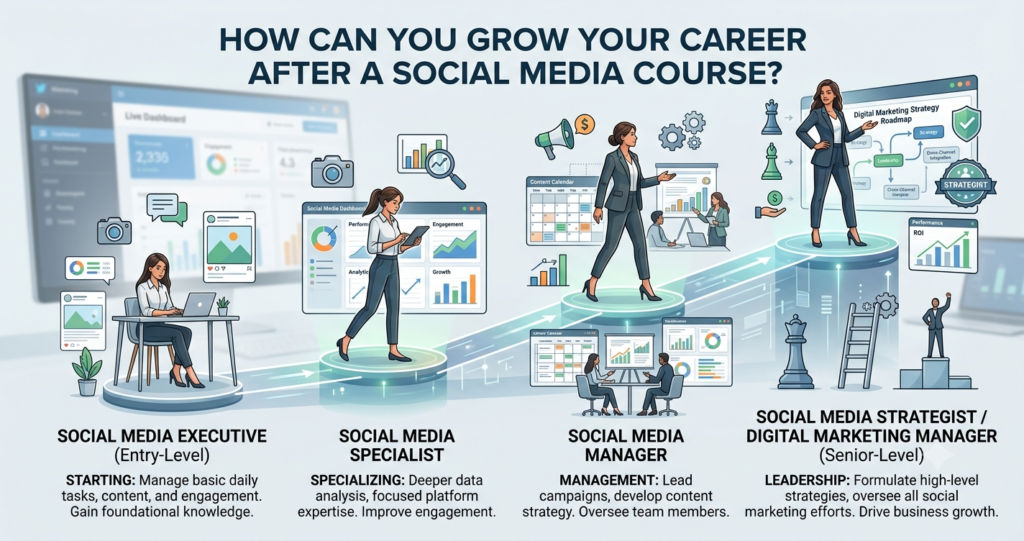
Completing a course should be viewed as the beginning of your learning journey rather than the end. Social platforms, advertising features, content formats, algorithms, and audience behaviour continually change, so successful professionals continue developing their knowledge.
Your first objective should be to gain practical experience and establish a strong foundation. After that, choose a specialisation that matches your interests and market demand. For example, you could develop advanced skills in paid advertising, analytics, influencer campaigns, short-form video, social commerce, or social media strategy.
Move From Execution to Strategy
Early-career professionals often focus on executing assigned tasks. As you gain experience, learn to understand the business reason behind those tasks. Instead of simply asking, “What should we post?”, begin asking, “Who are we trying to reach, what action do we want them to take, and how will we measure success?” This strategic mindset can help you progress towards senior positions.
Develop Data-Driven Marketing Skills
Analytics can distinguish a content producer from a strategic social media professional. Learn how to analyse campaign results and use insights to improve future content. Being able to explain why engagement increased, why an advertisement performed poorly, or which content generated leads makes your contribution more valuable to an organisation.
Learn Complementary Digital Marketing Skills
Social media becomes even more powerful when combined with related disciplines. Learning SEO, email marketing, content marketing, Google Analytics, paid advertising, conversion optimisation, and basic web analytics can help you develop into a more versatile digital marketer. This broader knowledge can eventually create opportunities beyond social media-specific roles.
Conclusion
A social media course can provide a practical starting point for building a career in the expanding digital marketing industry. What jobs can you get after a social media course ultimately depends on the combination of your training, practical skills, portfolio, experience, and chosen specialisation. From Social Media Executive and Content Creator roles to advertising, analytics, influencer marketing, management, and freelancing, there are numerous directions to explore.
The most effective approach is to move beyond simply earning a certificate. Build real or sample campaigns, develop a portfolio, learn social media analytics, strengthen your communication and content creation skills, and understand how social media contributes to wider business objectives. With continuous learning and measurable experience, your first social media job can become the foundation for a long-term digital marketing career.
Explore Our Recent Blog
- Digital Marketing Course Syllabus: What Will You Learn?
- Social Media Marketing Course Syllabus Explained
- How to Choose the Right Digital Marketing Course?
- Instagram Marketing Skills You Should Learn
- Social Media Marketing Tools Beginners Should Know
Frequently Asked Questions
1. What jobs can you get after a social media course with no experience?
You can apply for entry-level roles such as Social Media Executive, Social Media Coordinator, Junior Content Creator, Community Management Assistant, or Digital Marketing Intern. A practical portfolio can help compensate for limited professional experience. Freelance projects and internships can also help you build evidence of your abilities.
2. Is a social media course enough to get a job?
A course can provide the foundational knowledge required to start applying for jobs, but it is rarely the only factor employers consider. You should combine your training with practical projects, a strong portfolio, communication skills, and familiarity with relevant tools. Demonstrating that you can plan, create, manage, and analyse social media campaigns can make your profile stronger.
3. What skills should I learn after completing a social media course?
Focus on content creation, copywriting, social media strategy, audience research, community management, analytics, paid advertising, and campaign reporting. You should also develop basic design and video-editing skills because visual content is important across many platforms. Learning complementary areas such as SEO and content marketing can further expand your career options.
4. Can I become a social media manager after a course?
You can work towards becoming a Social Media Manager, but many employers expect some practical experience before assigning full strategic responsibility. Starting in an executive, coordinator, or junior specialist role can help you develop the necessary experience. Building successful campaigns and demonstrating measurable results can support progression into management.
5. Can I earn money as a freelance social media manager?
Yes, social media management can be offered as a freelance service to businesses, creators, startups, and organisations. Your earning potential will depend on your skills, service offerings, client base, experience, and ability to demonstrate results. Beginners should focus first on developing reliable services, a professional portfolio, and strong client relationships.
6. What jobs can you get after a social media course in digital marketing?
You can explore Social Media Executive, Social Media Manager, Content Creator, Community Manager, Influencer Marketing Executive, Social Media Advertising Specialist, Social Media Analyst, and Content Marketing Executive roles. Your options become broader when you combine social media knowledge with SEO, paid advertising, analytics, and content marketing. Over time, these skills can lead to wider digital marketing and strategic positions.
