
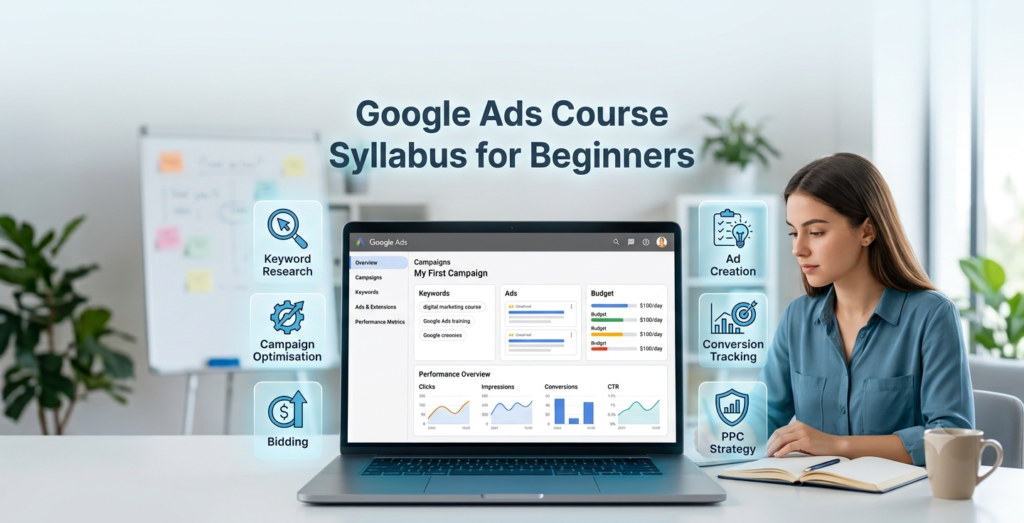
Learning Google Ads can help beginners understand how businesses use paid search to reach potential customers, generate website traffic, and support sales. A well-structured Google Ads Course Syllabus for Beginners usually starts with the fundamentals of online advertising before moving into campaign creation, keyword research, ad copy, bidding, targeting, conversion tracking, and optimisation. This makes it easier for new learners to understand both the technical and strategic sides of paid advertising.
A practical Google Ads Course Syllabus for Beginners should not focus only on creating advertisements. Beginners also need to understand how search intent, keywords, landing pages, budgets, bidding strategies, and campaign performance work together. The Google Ads training syllabus should therefore combine theoretical concepts with practical campaign-building exercises. This approach helps learners understand what happens before, during, and after an advertisement is launched.
What Does a Google Ads Course Syllabus for Beginners Usually Include?
A comprehensive Google Ads Course Syllabus for Beginners generally covers the complete journey from setting up an advertising account to analysing campaign results. The first stage usually introduces Google Ads, paid search advertising, search engine marketing, advertising objectives, and the Google Ads interface. Beginners learn how paid advertisements appear in search results and how advertisers are charged for clicks or other forms of interaction.
A strong Google Ads training syllabus should also explain how different elements influence campaign performance. Learners need to understand concepts such as Quality Score, Ad Rank, click-through rate, cost per click, conversion rate, and return on advertising spend. These metrics help beginners move beyond simply creating ads and start evaluating whether their campaigns are producing meaningful results.
Core topics generally covered
- Google Ads Fundamentals: Learn how Google Ads works, including PPC, paid search, campaign objectives, and basic terminology. Understand how businesses use targeted ads to reach potential customers.
- Account Structure: Learn how campaigns, ad groups, keywords, ads, and assets are organised in Google Ads. Understand how proper structure supports effective campaign management.
- Keyword Research: Learn how to find relevant keywords based on search intent, competition, relevance, and business goals. Understand how keywords connect user searches with advertisements.
- Ad Creation: Learn how to write relevant headlines and descriptions that clearly communicate a product or service’s value. Understand how effective ad copy can encourage users to take action.
- Bidding and Budgeting: Learn about manual and automated bidding strategies and how campaign budgets are planned. Understand how advertisers can manage spending according to campaign objectives.
- Campaign Optimisation: Learn how to analyse campaign results and identify areas that need improvement. Understand how data-driven changes can improve targeting, ads, budgets, and performance.
How Should Beginners Learn Google Ads Campaign Setup?
Campaign setup is one of the most important components of a Google Ads Course Syllabus for Beginners because it teaches learners how to turn an advertising objective into an actual campaign. Beginners first need to understand the purpose of the campaign. A business may want website traffic, leads, phone calls, online purchases, or brand visibility. The campaign settings should support the selected objective.
Students should also learn how campaign structure affects account management. Separating different products, services, locations, or objectives into appropriate campaigns can make performance analysis easier. The PPC course syllabus should therefore teach learners how to build a logical account structure that remains manageable as advertising activity grows.
Important Campaign Setup Skills
- Campaign Objectives: Select campaign objectives according to business goals, such as leads, sales, website visits, or conversions. Choose an objective that matches the desired outcome of the advertising campaign.
- Geographic Targeting: Choose countries, states, cities, or specific service areas based on the target audience. This helps businesses show advertisements to users in relevant locations.
- Language Settings: Configure language targeting according to the audience and campaign requirements. This helps advertisements reach users who are likely to understand the ad content.
- Daily Budget: Set a suitable daily budget by considering expected traffic, competition, and campaign objectives. Monitor spending regularly to ensure the budget supports the campaign goals.
- Ad Scheduling: Decide when advertisements should be eligible to appear based on audience behaviour and business hours. Scheduling can help businesses manage when their ads are shown.
- Campaign Organisation: Organise campaigns logically according to products, services, locations, or objectives. A clear structure makes campaign performance easier to monitor and optimise.
How Does Keyword Research Work in a Google Ads Course?
Keyword research is a central part of the Google Ads Course Syllabus for Beginners because keywords connect user searches with advertisements. Beginners learn how people search for products, services, information, and solutions online. They then identify relevant keywords that match the search intent of their target audience.
The Google Ads training syllabus should introduce practical keyword research methods and tools. Learners can examine search terms, competitor themes, industry terminology, and keyword suggestions to build a useful keyword list. They should also learn how to group closely related keywords into relevant ad groups so that advertisements can closely match users’ searches.
Keyword Research Concepts Beginners Should Understand
- Search Intent: Identify whether users are searching for information, a product, a service, or a specific solution. Understanding intent helps select keywords that match what potential customers want.
- Keyword Relevance: Choose keywords that are closely related to the advertised product, service, or business. Relevant keywords help connect advertisements with users who are more likely to be interested.
- Match Types: Understand how broad, phrase, and exact match influence when advertisements may appear. Using the right match type helps control how closely searches need to relate to selected keywords.
- Negative Keywords: Identify and exclude irrelevant searches that may waste advertising budget. Negative keywords help prevent ads from appearing for searches that do not support campaign objectives.
- Keyword Grouping: Organise closely related keywords into focused ad groups based on topics or services. This helps maintain stronger connections between keywords, advertisements, and landing pages.
- Search Terms: Review the actual searches that triggered advertisements after campaigns begin running. Use this data to identify useful keywords, irrelevant searches, and optimisation opportunities.
What Will Beginners Learn About Google Search Ads and Ad Copy?
Search advertising is another major section of the Google Ads Course Syllabus for Beginners. Learners discover how text advertisements can appear when people search for relevant terms. The course should explain the relationship between keywords, search queries, advertisements, ad assets, landing pages, and user intent.
A useful PPC advertising course should also explain how advertisers can test different messages. Instead of assuming that one advertisement will always perform best, learners can create variations based on different benefits, calls to action, offers, or value propositions. Performance data can then be used to identify opportunities for improvement.
Search Ad Skills Included in a Beginner Syllabus
- Headline Writing: Create clear and relevant headlines that connect the user’s search with the advertised product or service. Use concise messaging to communicate the main value of the offer.
- Description Writing: Explain key benefits, features, trust factors, and calls to action within the available space. Keep the description relevant to the user’s search and campaign objective.
- Ad Relevance: Maintain a strong connection between keywords, advertisements, and landing pages. Relevant messaging helps create a consistent experience from search to website.
- Calls to Action: Use clear action-oriented language that encourages users to take the desired next step. Choose calls to action that match the campaign objective, such as enquiry, purchase, or sign-up.
- Ad Assets: Learn how additional information can make search advertisements more useful and informative. Assets can provide details such as links, locations, contact options, or other relevant information.
- Ad Testing: Compare different headlines, descriptions, and messaging approaches to understand what performs better. Use campaign data to guide future improvements and optimisation.
How Do Bidding and Budgeting Work in a Google Ads Course Syllabus?
Bidding and budgeting are essential parts of a Google Ads Course Syllabus for Beginners because advertising performance depends not only on keywords and advertisements but also on how campaigns use available budgets. Beginners should first understand the relationship between campaign budget, bids, competition, clicks, and conversions.
Budget management should also receive practical attention. Learners need to understand that increasing a budget does not automatically guarantee better business results. The Google Ads training syllabus should teach students to examine campaign performance, identify where budget is being spent, and determine whether the traffic generated is relevant and valuable.
Budget and Bidding Concepts
- Cost Per Click: Understand how advertisers may incur costs when users click on search advertisements. Learn how CPC can affect overall campaign spending and performance.
- Daily Budget: Learn how a campaign’s daily budget helps manage advertising spend over time. Understand how budget levels can influence the amount of traffic a campaign can receive.
- Manual Bidding: Understand how manual bidding can give advertisers greater control over individual keyword or ad group bids. Learn when direct bid management may be useful for campaign control.
- Automated Bidding: Learn how automated bidding uses selected campaign goals and available signals to adjust bids. Understand how automation can support different advertising objectives.
- Conversion-Based Bidding: Understand bidding strategies that focus on generating desired actions, such as leads, purchases, or sign-ups. Learn why conversions can be more meaningful than clicks for some campaigns.
- Budget Optimisation: Review campaign performance and allocate spending according to business priorities. Learn how data can help identify areas where budget adjustments may be appropriate.
What Campaign Types Should Beginners Learn in Google Ads?
A complete Google Ads Course Syllabus for Beginners should introduce learners to the major campaign formats available within the Google advertising ecosystem. Search campaigns are usually an important starting point because they help beginners understand keywords, search intent, ad relevance, and paid search fundamentals.
The objective should not be to make beginners experts in every campaign type immediately. Instead, the Google Ads course syllabus should help learners understand when different campaign formats may be relevant and what type of business objective each can support. Practical examples can make these concepts easier to understand.
Campaign Formats Beginners Can Explore
- Search Campaigns: Learn how search advertisements can reach users actively looking for relevant products or services. Understand how keywords and search intent help connect ads with potential customers.
- Display Campaigns: Understand how visual advertisements can appear across eligible websites, applications, and other placements. Learn how display advertising can support awareness and audience reach.
- Video Campaigns: Explore advertising formats designed to reach audiences through video content. Understand how video ads can support awareness, engagement, and other campaign objectives.
- Shopping Campaigns: Learn the fundamentals of product-focused advertising for eligible online retailers. Understand how product information can be used to promote items to potential shoppers.
- Performance Max: Understand Google’s broader automated campaign approach across eligible advertising inventory. Learn how it can support different objectives using multiple Google channels.
- Remarketing Campaigns: Learn how businesses can reconnect with people who have previously interacted with their website or digital presence.
How Can Beginners Track Conversions and Measure Google Ads Performance?

Conversion tracking should be a major component of any Google Ads Course Syllabus for Beginners because clicks alone do not always indicate business success. A campaign may receive substantial traffic but generate few leads or sales. Beginners therefore need to understand how to identify and measure meaningful actions.
The Google Ads training syllabus should also teach learners how to interpret important performance metrics. Metrics such as impressions, clicks, click-through rate, cost per click, conversions, conversion rate, cost per conversion, and conversion value can provide different perspectives on campaign performance. Learners should avoid analysing a single metric without considering the wider campaign objective.
Campaign Formats Beginners Can Explore
- Search Campaigns: Learn how search advertisements can reach users actively looking for relevant products or services. Understand how keywords and search intent help connect ads with potential customers.
- Display Campaigns: Understand how visual advertisements can appear across eligible websites, applications, and other placements. Learn how display advertising can support awareness and audience reach.
- Video Campaigns: Explore advertising formats designed to reach audiences through video content. Understand how video ads can support awareness, engagement, and other campaign objectives.
- Shopping Campaigns: Learn the fundamentals of product-focused advertising for eligible online retailers. Understand how product information can be used to promote items to potential shoppers.
- Performance Max: Understand Google’s broader automated campaign approach across eligible advertising inventory. Learn how it can support different objectives using multiple Google channels.
- Remarketing Campaigns: Learn how businesses can reconnect with people who have previously interacted with their website or digital presence.
How Can a Beginner Optimise Google Ads Campaigns After Launch?
Campaign optimisation is where a Google Ads Course Syllabus for Beginners moves from basic setup towards practical advertising management. Once a campaign has collected sufficient data, learners can examine keywords, advertisements, search terms, audiences, locations, devices, and conversion performance to identify potential improvements.
A strong PPC course syllabus should also teach learners to make changes carefully. Making too many changes at once can make it difficult to understand which adjustment influenced performance. Beginners should therefore learn to monitor changes over an appropriate period and compare relevant performance data before making further decisions.
Practical Optimisation Activities
- Search Term Review: Identify irrelevant or low-value searches that may not support campaign objectives. Add suitable negative keywords to reduce unwanted traffic and improve targeting.
- Keyword Optimisation: Review keyword performance and identify terms that need improvement or adjustment. Organise keywords into relevant ad groups to maintain better campaign structure.
- Ad Testing: Test different headlines, benefits, messages, and calls to action while keeping ads relevant. Compare performance data to identify useful opportunities for improvement.
- Budget Review: Examine campaign spending patterns and compare them with performance and objectives. Adjust budget allocation where appropriate to support important campaign priorities.
- Landing Page Analysis: Check whether landing pages are relevant, useful, mobile-friendly, and aligned with the advertisements. Ensure visitors can easily find the information or action promised in the ad.
- Performance Monitoring: Regularly review important campaign metrics and record significant changes. Use performance data to understand campaign development and guide future optimisation.
What Practical Projects Should Be Included in a Google Ads Course for Beginners?
A practical component can make the Google Ads Course Syllabus for Beginners much more useful because students can apply concepts rather than only reading about them. A beginner-friendly project may involve creating a sample campaign for a fictional business. The learner can identify an objective, research keywords, organise ad groups, write advertisements, select targeting settings, and prepare a campaign structure.
Learners can also create a basic Google Ads campaign report after completing a practical exercise. The report can explain the campaign objective, selected keywords, targeting approach, advertising budget, performance metrics, observations, and proposed optimisation steps. This type of practical work can help beginners build confidence and demonstrate their understanding.
Suggested Beginner Projects
- Search Campaign Project: Build a sample search campaign for a selected product or service. Create the campaign structure, choose relevant keywords, and develop suitable advertisements.
- Keyword Research Project: Create a structured keyword list and classify terms according to search intent. Group relevant keywords and identify negative keywords for better targeting.
- Ad Copy Project: Develop multiple search advertisement variations for selected ad groups. Create relevant headlines, descriptions, and calls to action for each variation.
- Campaign Audit: Analyse sample campaign data and identify areas that require improvement. Review keywords, ads, budgets, targeting, and performance metrics to find optimisation opportunities.
- Conversion Tracking Exercise: Create a basic measurement plan for important customer actions, such as leads, purchases, or sign-ups. Identify which conversions should be tracked to evaluate campaign performance.
- Performance Report: Prepare a simple report explaining campaign results and key performance metrics. Highlight important observations and suggest practical optimisation steps based on the available data.
What Skills Can You Develop After Completing a Google Ads Course Syllabus for Beginners?
Completing a Google Ads Course Syllabus for Beginners can provide learners with foundational paid advertising skills. Students can become familiar with account structure, keyword research, campaign setup, ad copywriting, bidding, budgeting, conversion tracking, and campaign optimisation. These skills can be useful for digital marketing roles and freelance advertising projects.
For people pursuing digital marketing careers, the skills covered by a Google Ads training syllabus can complement SEO, content marketing, social media marketing, email marketing, and analytics knowledge. Paid search and organic search have different mechanisms, but understanding both can help marketers develop a broader view of search engine marketing.
Career-Oriented Skills
- Paid Search Management: Understand the basic workflow involved in planning, launching, and managing paid search campaigns. Learn how different campaign elements work together to support advertising objectives.
- Keyword Research: Develop the ability to identify relevant and commercially valuable search terms. Learn how search intent, relevance, and competition influence keyword selection.
- Ad Copywriting: Learn to write concise and relevant advertisements that address user needs and business benefits. Develop skills in creating clear headlines, descriptions, and calls to action.
- Campaign Analysis: Learn to interpret important advertising metrics and identify performance patterns. Use campaign data to understand traffic, conversions, costs, and overall results.
- Conversion Tracking: Understand how valuable customer actions, such as leads, purchases, and sign-ups, can be measured. Learn why accurate tracking is important for evaluating campaign effectiveness.
- Optimisation: Develop a structured approach to improving campaigns using available performance data. Learn how to optimise keywords, advertisements, budgets, targeting, and landing pages.
Conclusion
A well-designed Google Ads Course Syllabus for Beginners should take learners from basic paid advertising concepts to practical campaign management. It should cover campaign structure, keyword research, search advertisements, bidding, budgeting, targeting, conversion tracking, reporting, and optimisation. The strongest learning approach combines theoretical knowledge with practical exercises so that students understand how different campaign components work together.
The Google Ads Course Syllabus for Beginners is particularly useful for learners who want to build a foundation in PPC advertising and search engine marketing. By practising campaign setup, keyword research, ad copywriting, performance analysis, and optimisation, beginners can develop skills that complement other areas of digital marketing. Continued practice and regular learning are important because advertising platforms, features, and best practices can change over time.
Explore Our Recent Blog
- Social Media Marketing Course Syllabus Explained
- How to Choose the Right Digital Marketing Course?
- Instagram Marketing Skills You Should Learn
- Social Media Marketing Tools Beginners Should Know
- What Jobs Can You Get After a Social Media Course?
Frequently Asked Questions
1. Is a Google Ads course suitable for complete beginners?
Yes, a beginner-focused Google Ads Course Syllabus for Beginners can start with basic concepts before introducing campaign management and optimisation. You do not necessarily need previous Google Ads experience to understand the fundamentals. Basic knowledge of digital marketing, search engines, and websites can make the learning process easier.
2. How long does it take to learn Google Ads as a beginner?
The learning period depends on how much time a student spends studying and practising. A structured Google Ads Course Syllabus for Beginners can teach the fundamentals within a relatively short training period, but practical confidence develops through repeated campaign exercises. Regular practice with keyword research, ad creation, reporting, and optimisation can strengthen understanding.
3. What topics should a beginner Google Ads course cover?
A comprehensive Google Ads Course Syllabus for Beginners should cover Google Ads fundamentals, campaign setup, keyword research, ad creation, bidding, budgeting, targeting, conversion tracking, performance metrics, and optimisation. It should ideally include practical exercises rather than focusing only on theory. Learners should also understand how landing pages and search intent influence advertising performance.
4. Do I need SEO knowledge before learning Google Ads?
No, SEO knowledge is not a mandatory requirement for starting Google Ads. However, understanding SEO concepts such as keywords, search intent, landing pages, and website structure can support your overall digital marketing knowledge. A Google Ads Course Syllabus for Beginners can teach the paid advertising concepts separately while showing how paid search fits into the broader search marketing environment.
5. Can I get a digital marketing job after learning Google Ads?
Learning Google Ads can provide one useful skill for digital marketing roles, particularly positions involving paid advertising or PPC. However, employers may also expect knowledge of analytics, SEO, content, social media, reporting, and other digital marketing areas depending on the role. A practical Google Ads Course Syllabus for Beginners can help learners build foundational advertising knowledge that they can combine with other skills.
6. Should beginners practise Google Ads before working on real client campaigns?
Practical experience is valuable before managing campaigns for clients because advertising involves budgets, targeting decisions, tracking, and performance analysis. Beginners can start with structured exercises, sample campaigns, or supervised projects to understand the workflow. After completing a Google Ads Course Syllabus for Beginners, learners should continue practising campaign analysis and optimisation before taking responsibility for significant advertising budgets.
