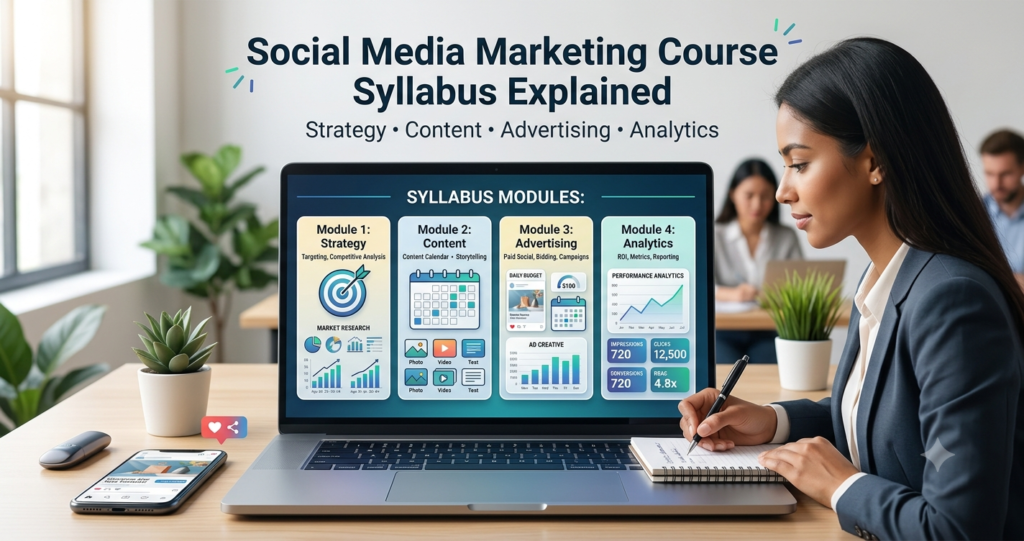
Understanding a Social Media Marketing Course Syllabus helps beginners know exactly what they will learn before enrolling in a course. Social media marketing has become an essential part of digital marketing, helping businesses build brand awareness, engage customers, generate leads, and increase online visibility. A well-structured course introduces learners to important areas such as social media strategy, content creation, platform management, paid advertising, audience targeting, and performance analytics.
The Social Media Marketing Course Syllabus usually progresses from basic concepts to practical campaign management, making it suitable for students, aspiring marketers, entrepreneurs, and freelancers. Depending on the programme, learners may also explore Facebook marketing, Instagram marketing, LinkedIn marketing, influencer marketing, social media analytics, and campaign optimisation.
Understanding these modules can help learners choose the right course for their career goals and develop practical skills needed to manage successful social media campaigns in today’s competitive digital environment.
What Does a Social Media Marketing Course Syllabus Usually Include?
A typical Social Media Marketing Course in Delhi covers the complete process of developing and managing social media campaigns. Learners generally begin with social media fundamentals before progressing towards platform-specific marketing, content strategy, paid advertising, analytics, and campaign optimisation. This progression allows beginners to build knowledge systematically instead of attempting advanced advertising techniques without understanding the basics.
The strongest programmes also connect different areas of digital marketing. For example, social media content can support SEO, paid campaigns can generate website traffic, and analytics can help marketers understand which content produces conversions. Students should therefore look for a curriculum that explains social media as part of a broader digital marketing strategy rather than treating individual platforms as completely separate subjects.
Core Topics Usually Covered
- Social Media Marketing Fundamentals: Learners understand the role of social media in modern marketing, including brand awareness, engagement, lead generation, customer retention, and sales.
- Social Media Strategy: This section teaches students how to establish objectives, identify target audiences, research competitors, select platforms, and develop an actionable social media plan.
- Content Creation: Students learn how to develop captions, images, videos, reels, stories, carousels, and other formats. They may also explore content calendars, storytelling techniques, brand voice, and creative planning.
- Platform Marketing: A syllabus commonly introduces Facebook, Instagram, LinkedIn, YouTube, and other relevant networks. Learners discover how audience behaviour, content formats, algorithms, and marketing opportunities differ across platforms.
- Social Media Advertising: Paid social media marketing teaches learners how to create campaigns, select objectives, define audiences, set budgets, develop advertisements, and monitor performance.
- Analytics and Reporting: Students learn to interpret metrics such as reach, impressions, engagement, clicks, conversions, cost per result, and return on advertising spend.
How Do You Learn Social Media Marketing from Beginner to Advanced Level?
A quality Social Media Marketing Course Syllabus should follow a progressive learning structure. Beginners first need to understand how social media marketing works before learning advanced campaign optimisation. Starting with fundamentals makes later topics such as audience segmentation, retargeting, conversion tracking, and paid advertising much easier to understand.
At the intermediate level, learners can begin combining content, community engagement, platform management, and advertising. Advanced training should then focus on performance analysis, campaign optimisation, marketing funnels, testing, automation, and strategic decision-making. This progression is especially useful for learners who eventually want to work as social media managers, digital marketers, content strategists, or freelance marketing professionals.
A Typical Learning Progression
- Beginner Stage: Students learn social media terminology, major platforms, audience research, profile optimisation, basic content planning, and fundamental marketing concepts.
- Content Stage: Learners explore content pillars, formats, storytelling, captions, visual communication, hashtags, posting schedules, and content calendars.
- Strategy Stage: Students develop complete social media strategies based on business goals and audience needs. Competitor research, customer personas, platform selection, campaign objectives, and content planning become important components.
- Advertising Stage: Learners are introduced to paid social media campaigns, audience targeting, creative development, budgeting, bidding, and campaign objectives.
- Analytics Stage: Students learn to evaluate campaign performance using platform analytics and reporting tools. They identify successful content, weak campaigns, audience behaviour, and opportunities for optimisation.
- Advanced Stage: Advanced learners work with conversion funnels, retargeting, A/B testing, influencer campaigns, automation, social listening, and performance optimisation.
Which Social Media Platforms Are Covered in the Course?
Platform-specific marketing is an important part of most social media marketing programmes because every platform has different users, content formats, algorithms, and business opportunities. A comprehensive syllabus should explain not only how to use these platforms but also how to decide which ones are suitable for a particular business or campaign.
For example, Instagram may be particularly useful for visual storytelling and short-form video, while LinkedIn is commonly used for professional networking, B2B marketing, thought leadership, and employer branding. Facebook can support community building, advertising, and broad audience reach, whereas YouTube can be valuable for long-form educational or entertainment content. The syllabus should teach students to make platform choices based on audience and objectives rather than simply maintaining accounts everywhere.
Major Platforms Students May Study
- Facebook Marketing: Students learn page management, content publishing, audience engagement, community building, Facebook advertising, and campaign performance analysis.
- Instagram Marketing: Topics may include Instagram content strategy, Reels, Stories, carousels, hashtags, engagement, creator collaborations, and Instagram advertising.
- LinkedIn Marketing: Learners explore personal branding, company pages, professional content, B2B lead generation, networking, and LinkedIn advertising.
- YouTube Marketing: Students may learn channel optimisation, video content planning, thumbnails, titles, descriptions, audience retention, and YouTube analytics.
- X and Other Platforms: Depending on the programme, learners may be introduced to X, Pinterest, Snapchat, TikTok, or emerging networks.
- Platform Selection: Students learn how to choose networks based on customer demographics, business objectives, content resources, industry requirements, and available marketing budgets.
What Do You Learn About Social Media Content Creation?
Content creation is one of the most practical areas of a social media marketing syllabus. Students learn that effective social media content involves much more than creating attractive posts. Content must communicate a clear message, address audience needs, reflect the brand identity, encourage interaction, and contribute towards a measurable marketing objective.
A comprehensive curriculum can introduce different content formats and explain when each should be used. Learners may create educational posts, promotional content, testimonials, behind-the-scenes material, videos, Reels, Stories, polls, carousels, and user-generated content. They also learn how to organise these formats within a content calendar so that the brand maintains consistent communication.
Important Content Creation Skills
- Content Strategy: Students learn how to establish content pillars and connect them with business objectives. This creates a consistent direction for social media rather than relying on random daily posts.
- Copywriting: Learners practise writing attention-grabbing headlines, captions, calls to action, and promotional messages. Strong copywriting helps communicate value clearly while encouraging users to take the next step.
- Visual Content: Courses may teach basic principles of graphic design, composition, typography, branding, and visual consistency. Students may also use tools such as Canva to create practical social media assets.
- Short-Form Video: Reels, Shorts, Stories, and similar formats are increasingly important in social media strategies. Learners may explore scripting, hooks, editing concepts, storytelling, and audience retention.
- Content Calendars: Students learn how to plan content in advance using weekly or monthly calendars. This improves consistency and allows campaigns to be coordinated around launches, events, offers, and important dates.
- Engagement Content: Interactive formats such as questions, polls, quizzes, discussions, and community posts can encourage participation.
How Does Social Media Advertising Work?

Social media advertising is generally an important part of an advanced Social Media Marketing Course Syllabus because businesses often use paid campaigns to reach specific audiences more efficiently. Students learn how advertising platforms allow marketers to define campaign objectives, audiences, placements, budgets, creatives, and performance goals.
A good curriculum should go beyond explaining where to click inside an advertising platform. Learners should understand why a campaign is being created, which audience should see it, what message should be communicated, and which metric should determine success. They should also learn how to interpret campaign data and make changes based on actual performance.
Paid Social Media Marketing Topics
- Campaign Objectives: Students learn how different objectives support goals such as awareness, traffic, engagement, leads, app promotion, or conversions.
- Audience Targeting: Learners explore demographic, geographic, interest-based, behavioural, custom, and other targeting approaches where available.
- Ad Creatives: Courses may teach the fundamentals of developing images, videos, headlines, captions, and calls to action for advertisements.
- Budgeting: Students learn how advertising budgets are allocated and monitored. They may study daily budgets, campaign-level budgeting, cost control, and basic financial considerations.
- Retargeting: Retargeting strategies help businesses reconnect with users who have previously interacted with their website, content, or brand. Students learn how these audiences can support conversion-focused campaigns.
- Campaign Optimisation: Learners analyse performance data and make informed changes to audiences, creatives, placements, budgets, and messaging.
What Analytics and Reporting Skills Are Included?
Analytics transforms social media marketing from an activity-based process into a measurable business function. A strong syllabus teaches learners how to determine whether their campaigns are actually achieving their objectives. Instead of focusing only on likes and followers, students learn to examine meaningful metrics related to engagement, traffic, leads, conversions, and advertising performance.
Social media analytics also helps marketers identify patterns over time. For example, a report may reveal that certain content formats receive stronger engagement or that a particular audience segment produces more conversions. Learners can use these insights to improve future campaigns, refine content strategies, and communicate marketing results to clients or managers.
Key Analytics Areas
- Reach and Impressions: These metrics help learners understand how widely content is being distributed and how frequently it is being displayed. Comparing them can provide useful context about content visibility.
- Engagement Metrics: Likes, comments, shares, saves, and other interactions help indicate audience response. Students learn that engagement should be interpreted according to the campaign objective rather than viewed in isolation.
- Traffic Analysis: Learners examine clicks and website visits generated from social platforms. Tracking traffic helps connect social media activity with broader digital marketing performance.
- Lead and Conversion Tracking: Advanced courses may introduce conversion tracking and attribution concepts. These skills help marketers understand whether social campaigns are producing valuable business actions.
- Advertising Metrics: Students may analyse metrics such as cost per click, cost per lead, conversion rate, and return on advertising spend. These indicators help evaluate paid campaign efficiency.
- Reporting: Learners practise preparing social media reports that clearly communicate results, insights, challenges, and recommendations. Good reporting turns raw numbers into useful business decisions.
How Can a Social Media Marketing Course Help Build a Career?
A well-designed social media marketing course can help learners develop practical skills for several digital marketing career paths. Social media is used across industries, meaning trained professionals may find opportunities with agencies, startups, established companies, e-commerce brands, educational organisations, service businesses, and personal brands.
However, completing a course alone does not guarantee employment or freelance success. Learners should combine course knowledge with practical projects, a portfolio, platform familiarity, communication skills, and an understanding of business objectives. A strong syllabus should therefore include assignments that allow students to demonstrate what they have learned.
Career Skills You Can Develop
- Social Media Manager: Students can learn how to plan content, manage social accounts, coordinate campaigns, respond to audiences, and prepare performance reports.
- Social Media Executive: Entry-level professionals can support content publishing, engagement, research, reporting, and campaign execution.
- Content Strategist: Learners who enjoy planning and storytelling can develop skills in content pillars, audience research, editorial calendars, and brand communication.
- Paid Media Specialist: Students interested in advertising can develop expertise in audience targeting, campaign setup, creative testing, budgeting, and optimisation.
- Freelance Social Media Marketer: Freelancers can offer content planning, account management, social media advertising, reporting, and strategy services to clients.
- Digital Marketing Professional: Social media skills can complement SEO, email marketing, content marketing, analytics, and other digital disciplines.
What Practical Projects Should a Social Media Marketing Course Include?
Practical assignments are essential because social media marketing is an execution-oriented discipline. Reading about campaign strategy does not provide the same learning experience as creating a strategy, developing content, launching a simulated campaign, and analysing its performance. Therefore, learners should look for a curriculum that includes projects alongside theoretical lessons.
Practical projects also provide valuable portfolio material. A beginner can create a sample social media strategy for a local business, develop a month-long content calendar, design platform-specific posts, prepare an advertising campaign structure, and create an analytics report. These examples can demonstrate practical thinking to prospective employers or clients.
Useful Course Projects
- Social Media Audit: Students analyse an existing brand’s social presence and identify strengths, weaknesses, content gaps, audience opportunities, and improvement areas.
- Content Calendar: Learners create a structured monthly calendar containing content themes, formats, captions, posting dates, and calls to action. This demonstrates their ability to organise a consistent content strategy.
- Platform Strategy: Students develop separate strategies for platforms such as Instagram, Facebook, and LinkedIn. This teaches them how to adapt communication rather than copying identical content everywhere.
- Paid Campaign Plan: Learners create a hypothetical advertising campaign with an objective, target audience, creative concept, budget, and measurement plan.
- Influencer Campaign: Students design a creator or influencer marketing campaign based on a target audience and brand objective. They may assess influencer relevance, content ideas, deliverables, and performance indicators.
- Performance Report: Learners analyse a campaign dataset and prepare a report containing results, insights, problems, and recommendations. This helps develop the analytical thinking required for professional social media management.
What Tools Are Commonly Taught in a Social Media Marketing Course?
Tools can significantly improve productivity in social media management, content creation, advertising, analytics, and reporting. However, the exact software included in a Social Media Marketing Course Syllabus depends on the institute and course level. Beginners should prioritise learning the underlying marketing principles first and then understand how tools support those principles.
A strong programme may introduce content design tools, social scheduling platforms, analytics dashboards, keyword or audience research tools, advertising platforms, and reporting software. Students should also learn that tools change frequently, so the ability to understand workflows and marketing concepts is more valuable than memorising one specific interface.
Common Tool Categories
- Design Tools: Platforms such as Canva can help learners create social media graphics, presentations, carousels, and other visual assets. Basic design knowledge can improve the quality and consistency of branded content.
- Scheduling Tools: Social media management platforms allow marketers to organise, schedule, and monitor posts. These tools can make publishing workflows more efficient for businesses managing multiple accounts.
- Analytics Tools: Native platform analytics and third-party reporting tools help marketers evaluate performance. Learners should understand how to extract meaningful insights rather than simply collect numbers.
- Advertising Platforms: Students may work with Meta Ads Manager and other platform-specific advertising systems. These environments provide practical experience with campaign creation and performance monitoring.
- Content Research Tools: Research tools can help identify trends, audience interests, competitors, and content opportunities. These insights can support more relevant and data-informed content planning.
- Reporting Tools: Spreadsheet and dashboard tools can help organise campaign data and present results clearly. Professional reporting skills are especially useful when working with clients or marketing teams.
Conclusion
Understanding the Social Media Marketing Course Syllabus before choosing a programme can help learners make a more informed education and career decision. A comprehensive curriculum should cover the complete social media marketing process, from audience research and strategy development to content creation, platform management, paid advertising, analytics, and optimisation. It should also balance theoretical knowledge with practical assignments.
The most valuable social media marketing skills are not limited to creating attractive posts. Successful marketers need to understand audiences, develop purposeful strategies, communicate effectively, analyse performance, and continuously improve campaigns. Learning these skills through structured training can provide a strong foundation for employment, freelancing, entrepreneurship, and broader digital marketing careers.
Explore Our Recent Blog
- Technical SEO Basics Every SEO Beginner Should Know
- What Is Digital Marketing, and How Does It Work?
- Social Media Skills Every Beginner Should Learn
- Digital Marketing Course Syllabus: What Will You Learn?
Frequently Asked Questions
1. What is included in a Social Media Marketing Course Syllabus?
A typical syllabus includes social media fundamentals, strategy, content creation, platform marketing, advertising, analytics, community management, and campaign optimisation. Advanced programmes may also include influencer marketing, retargeting, automation, and social listening. The exact modules vary by institute and course level.
2. Is a social media marketing course suitable for beginners?
Yes, many social media marketing courses are designed to start with basic concepts before progressing to advanced topics. Beginners can learn how platforms work, how to create content, how to develop strategies, and how to measure performance. Practical projects can make the learning process more useful for students with no professional experience.
3. Does the course teach Facebook and Instagram marketing?
Many comprehensive programmes include Facebook and Instagram because they are important channels for both organic content and paid advertising. Students may learn content planning, audience engagement, platform management, advertising, and analytics. The depth of coverage depends on the individual course syllabus.
4. Will I learn social media advertising?
A comprehensive programme generally introduces paid social media marketing, including campaign objectives, audience targeting, creative development, budgeting, and performance measurement. Advanced courses may also cover retargeting, conversion tracking, testing, and campaign optimisation. Learners should check the syllabus to confirm which advertising platforms are included.
5. Can I become a social media manager after completing the course?
A course can provide foundational knowledge and practical skills required for social media management, but career readiness also depends on practical experience and portfolio development. Creating sample strategies, content calendars, campaigns, and reports can demonstrate your abilities to potential employers or clients. Communication, creativity, analytical thinking, and platform knowledge are also valuable.
6. What should I look for in the best social media marketing course?
Look for a curriculum that combines strategy, content creation, platform management, paid advertising, analytics, and practical projects. The course should also teach current marketing practices and provide opportunities to work on realistic assignments. A well-rounded syllabus is generally more valuable than one that focuses only on posting content.
