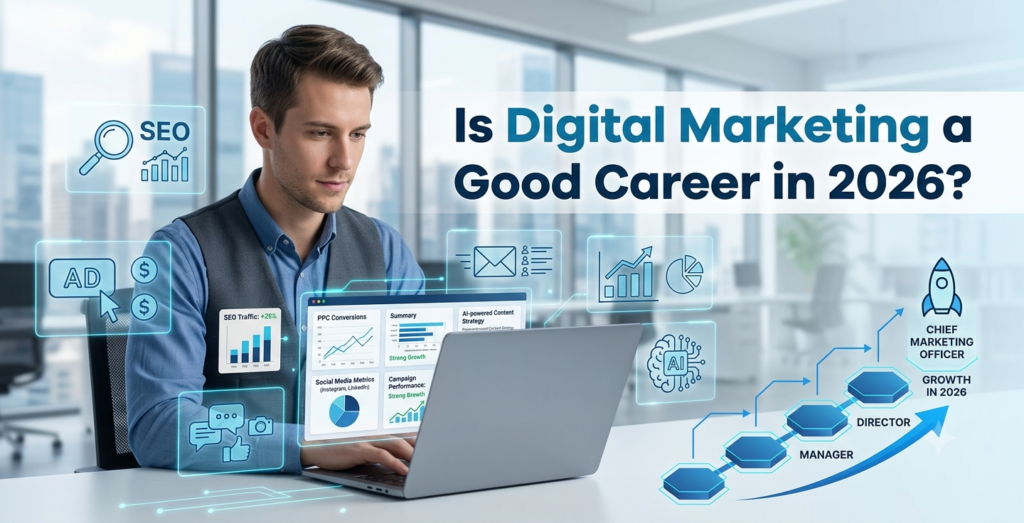
Is Digital Marketing a Good Career in 2026? This is an important question for students, freshers, graduates, career changers, and professionals looking to build skills in the digital economy. Digital marketing has become an important part of how businesses attract customers, generate leads, build brand awareness, and increase sales. From search engine optimisation and social media to paid advertising, email marketing, content strategy, and analytics, companies across industries depend on digital channels to reach their audiences.
This has created a wide range of career opportunities for people with creative, analytical, communication, and technical skills. The answer depends on your skills, interests, willingness to learn, and ability to adapt to changes in the industry. Digital marketing offers opportunities for freshers, graduates, career changers, freelancers, and experienced professionals, but competition has also increased.
Employers increasingly value practical skills, measurable results, portfolio projects, and specialised knowledge rather than basic familiarity with social media alone. As AI, automation, analytics, and changing search behaviour continue to influence the industry, professionals who keep developing relevant skills can explore different career paths within digital marketing.
Is Digital Marketing a Good Career in 2026 for Students and Freshers?
For students and freshers, digital marketing can provide an accessible entry point into the modern marketing industry. Unlike some highly technical professions, many entry-level digital marketing roles do not require advanced programming knowledge. Candidates can begin by learning SEO, content marketing, social media marketing, Google Ads, email marketing, analytics, and basic website optimisation before selecting an area in which to specialise.
If you are wondering Is Digital Marketing a Good Career in 2026?, consider how widely digital channels are used by businesses. E-commerce companies, educational institutions, healthcare organisations, real-estate companies, technology firms, financial businesses, manufacturers, restaurants, and local service providers all use online marketing to communicate with customers. This broad application creates opportunities for professionals with different educational and professional backgrounds.
Entry-Level Accessibility
- Low Barrier to Entry: Digital marketing allows beginners to start with foundational knowledge and gradually develop specialised expertise. A graduate from commerce, arts, science, management.
- Practical Learning: Students can create sample websites, blogs, social media campaigns, keyword research projects, email campaigns, or Google Ads practice projects.
- Multiple Career Paths: Beginners can explore SEO Executive, Content Writer, Social Media Executive, PPC Executive, Email Marketing Executive, Digital Marketing Executive, or Marketing Assistant positions.
- Certification Opportunities: Certifications from recognised platforms can support a beginner’s learning journey. However, certificates work best when combined with practical projects, tool knowledge.
- Portfolio Development: A portfolio can demonstrate skills that a traditional CV may not fully communicate. Case studies, content samples, keyword research, website audits, campaign reports.
- Continuous Growth: Digital marketing provides opportunities to keep learning after getting the first job. Professionals can gradually move from execution-focused positions towards specialist.
Is Digital Marketing a Good Career in 2026 with the Growth of AI?
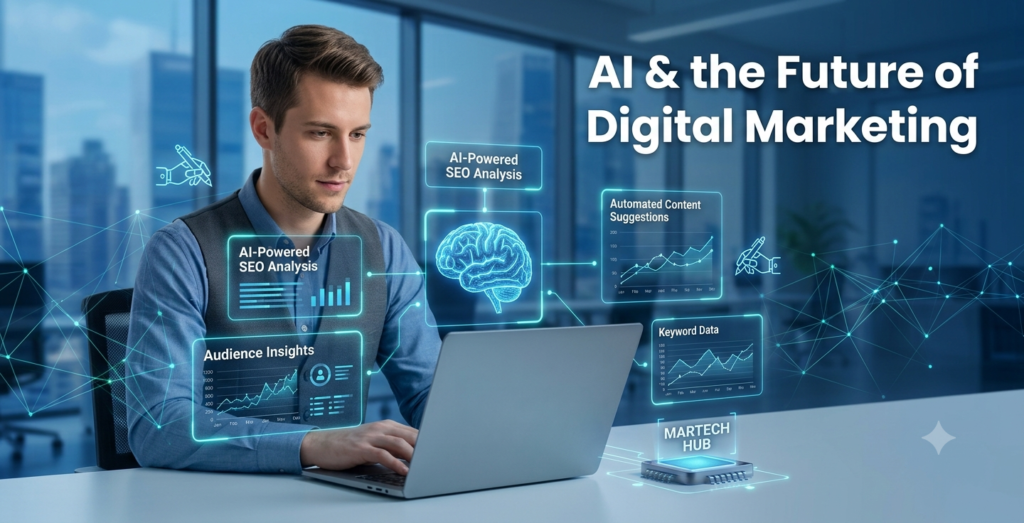
AI is one of the biggest changes affecting digital marketing in 2026. Marketers can now use AI tools for brainstorming, content outlines, keyword analysis, audience research, reporting assistance, creative variations, and other repetitive activities. This has changed how many marketing tasks are performed, but it does not remove the need for human judgement and strategic thinking.
When people ask Is Digital Marketing a Good Career in 2026?, they often connect the question with concerns about AI replacing marketing jobs. A more useful way to understand the change is to look at how responsibilities are shifting. Professionals who only perform repetitive tasks may need to develop additional skills, while marketers who understand strategy, data, customers, creativity, and technology can use AI as a productivity tool.
AI and the Changing Marketer
- Content Assistance: AI can help marketers create outlines, ideas, summaries, and initial drafts. Human professionals still need to check accuracy, originality, tone, search intent, brand requirements, and usefulness.
- SEO Research: AI can assist with topic research and content planning, but SEO professionals still need to understand search intent, technical SEO, internal linking, website architecture, quality signals, and performance data.
- Advertising Support: AI-based advertising systems can automate parts of targeting, bidding, and creative optimisation. Marketers still need to establish campaign objectives, budgets, tracking systems, messaging, and performance criteria.
- Data Interpretation: Automated dashboards can present large amounts of information quickly. Marketers need analytical skills to understand why traffic, leads, conversions, or engagement changed and what action should follow.
- Personalisation: AI can help businesses deliver more personalised experiences based on customer behaviour. Marketing professionals need to combine this technology with customer understanding.
- Human Creativity: Brand positioning, storytelling, emotional communication, strategic decisions, and understanding cultural context still require human involvement.
Is Digital Marketing a Good Career in 2026 in Terms of Job Opportunities?
Digital marketing careers now extend far beyond social media posting. Businesses require professionals who can improve organic search visibility, manage advertising campaigns, produce useful content, analyse customer behaviour, build email journeys, optimise conversions, and measure marketing performance. This creates opportunities across different industries and company sizes.
For anyone researching Is Digital Marketing a Good Career in 2026?, career diversity is one of the major factors to consider. You can work in an agency, an in-house marketing team, a startup, an e-commerce company, or as a freelancer. Your career can also develop from a general digital marketing position into a specialised role.
Major Career Opportunities
- SEO Specialist: SEO professionals work on keyword research, on-page optimisation, technical SEO, content strategy, internal linking, website audits, and organic performance.
- Performance Marketing Specialist: These professionals manage paid campaigns across platforms such as Google Ads and Meta Ads. They monitor metrics such as cost per click, cost per lead, conversion rate, and return on advertising spend.
- Content Strategist: Content strategists plan content around audience needs, search intent, business objectives, and brand positioning. The role increasingly involves coordinating different formats rather than producing only blog articles.
- Social Media Manager: Social media professionals develop content calendars, manage publishing, monitor engagement, analyse performance, and coordinate campaigns.
- Marketing Analyst: Marketing analysts use data to understand campaign performance and customer behaviour. Knowledge of analytics platforms, spreadsheets, dashboards, and data interpretation can be useful.
- Email and Automation Specialist: These professionals manage newsletters, customer journeys, segmentation, automation workflows, and retention campaigns.
Is Digital Marketing a Good Career in 2026 for Salary and Career Growth?
Salary is an important consideration when evaluating Is Digital Marketing a Good Career in 2026? However, there is no single salary applicable to every digital marketer. Compensation depends on experience, specialisation, location, company size, portfolio quality, technical skills, and the ability to demonstrate measurable business results.
Published 2026 India-focused salary guides show substantial variation between entry-level and experienced positions. One 2026 industry guide places typical fresher salaries around ₹3 – ₹6 LPA, while another gives broader entry-level ranges depending on role and experience. These figures should therefore be treated as indicative rather than guaranteed salaries.
Factors Affecting Salary
- Experience: Professionals generally gain access to more advanced responsibilities as they build experience. Managing campaigns, clients, budgets, strategies, or teams can influence compensation.
- Specialisation: Skills in areas such as technical SEO, performance marketing, marketing analytics, and automation can create different salary opportunities compared with basic generalist work.
- Portfolio: A portfolio can help demonstrate actual capabilities. Employers may find measurable examples more useful than a long list of tools without evidence of practical application.
- Location: Salary levels can vary between metropolitan and smaller cities. Remote hiring has also created opportunities for some professionals to work with companies outside their immediate location.
- Business Impact: Professionals who can connect marketing activities with traffic, leads, conversions, revenue, customer acquisition, or retention can communicate their value more effectively.
- Leadership: Career progression can eventually lead to roles such as Digital Marketing Manager, SEO Manager, Growth Manager, Head of Marketing, or other strategic positions, depending on experience and organisation.
Is Digital Marketing a Good Career in 2026 for Remote Work and Freelancing?
Digital marketing can support several working models, including office-based employment, hybrid work, remote employment, agency work, consulting, and freelancing. The suitability of each model depends on the employer, role, client requirements, experience, and ability to work independently.
For people asking Is Digital Marketing a Good Career in 2026?, remote work and freelancing can be attractive because many marketing activities can be performed online. SEO research, content production, analytics, campaign planning, reporting, social media management, and email marketing can often be handled digitally. However, remote work should not be assumed for every position.
Flexible Career Models
- In-House Employment: You work directly for one organisation and focus on its marketing goals. This can provide deeper knowledge of one brand, audience, product, and business model.
- Digital Marketing Agency: Agency professionals may manage campaigns for multiple clients across different industries. This can expose beginners to varied projects and marketing challenges.
- Remote Employment: Some organisations allow digital marketing professionals to work remotely because many responsibilities can be completed through online tools. Availability varies by employer and role.
- Freelancing: Freelancers provide specific marketing services to different clients. SEO, content writing, social media management, PPC, and website optimisation are common freelance services.
- Consulting: Experienced professionals can provide strategic recommendations to businesses without necessarily managing every execution task themselves.
- Entrepreneurship: Digital marketing skills can also support people building their own websites, online businesses, agencies, or digital products.
Is Digital Marketing a Good Career in 2026 for People Without a Marketing Degree?
A marketing degree can provide useful theoretical knowledge, but it is not the only route into digital marketing. Many employers focus on practical skills, portfolio evidence, communication, analytical thinking, and familiarity with relevant tools. This makes digital marketing an option worth considering for graduates from different academic backgrounds.
If you are asking Is Digital Marketing a Good Career in 2026? and do not have a marketing degree, focus on demonstrating what you can actually do. Instead of listing “SEO” or “social media marketing” on a CV without evidence, create practical examples that show your understanding of the work.
Building Employable Skills
- Learn the Fundamentals: Start with customer journeys, marketing funnels, search intent, branding, content strategy, paid advertising, and basic analytics. Understanding the complete marketing process makes specialised learning easier.
- Choose One Specialisation: Select an area such as SEO, content marketing, PPC, social media, email marketing, or analytics. Developing depth in one area can be more useful than having shallow knowledge of every channel.
- Learn Industry Tools: Depending on your specialisation, explore tools such as Google Search Console, GA4, Semrush, Google Ads, Meta Ads Manager, Canva, CRM platforms, and AI productivity tools.
- Create Practical Projects: Build sample audits, keyword research documents, content calendars, campaign plans, landing-page analyses, or reporting dashboards. These projects provide tangible evidence of learning.
- Develop Communication Skills: Digital marketers often explain strategies, reports, campaign results, and recommendations to clients or colleagues. Clear written and verbal communication can therefore support career growth.
- Measure Results: Learn how to connect marketing activity with measurable outcomes. Understanding traffic, impressions, clicks, conversions, leads, engagement, and customer acquisition can make your work more business-focused.
Is Digital Marketing a Good Career in 2026 for Long-Term Career Growth?
Long-term growth in digital marketing depends heavily on adaptability. Search engines change, advertising platforms introduce new features, customer behaviour evolves, AI tools become more capable, and businesses continually change their marketing priorities. A professional who stops learning may find that previously useful skills become less valuable.
When considering Is Digital Marketing a Good Career in 2026?, it is useful to think beyond the first job. A person might begin as an SEO Executive, Content Writer, PPC Executive, or Social Media Executive and later move towards specialist, strategist, managerial, consulting, or freelance positions.
Building a Sustainable Career
- Develop Specialisation: Start with a broad understanding of digital marketing, then develop deeper knowledge in one area. Specialisation can make your professional profile clearer.
- Add Analytics: Learn to interpret data rather than simply collect it. Analytics can help marketers explain what happened, why it happened, and what should be tested next.
- Understand Business Goals: Marketing activities should support business objectives such as awareness, leads, sales, retention, or customer loyalty. Understanding these goals makes marketing work more strategic.
- Keep Learning: Follow platform changes, SEO developments, advertising updates, AI tools, analytics practices, and changing consumer behaviour. Continuous learning is part of the profession.
- Build Professional Evidence: Keep records of projects, campaigns, improvements, reports, content samples, and case studies where permitted. A growing portfolio can support future career opportunities.
- Develop Strategic Thinking: As you progress, move beyond task execution. Learn to plan campaigns, identify opportunities, evaluate risks, allocate resources, and communicate recommendations.
Is Digital Marketing a Good Career in 2026, and How Can You Start?
If you are still asking Is Digital Marketing a Good Career in 2026?, the practical answer depends on whether the nature of the work matches your interests. People who enjoy a combination of creativity, communication, technology, research, data, and problem-solving may find the field suitable. People expecting quick results without continuous learning may find the industry more challenging.
The best way to test your interest is to begin with practical learning instead of spending months only studying theory. Choose one area, complete small projects, analyse your work, and gradually build a portfolio. Current career guidance also emphasises practical projects, specialisation, tool familiarity, and measurable results when preparing for digital marketing roles.
A Practical Starting Roadmap
- Month 1 – Learn Fundamentals: Understand SEO, content marketing, social media, PPC, email marketing, analytics, funnels, and customer journeys. The goal is to understand how different channels work together.
- Month 2 – Choose a Specialisation: Select SEO, performance marketing, content marketing, social media, email marketing, or analytics based on your interests. Avoid trying to become an expert in everything simultaneously.
- Month 3 – Practise With Projects: Create realistic projects such as a website SEO audit, keyword research report, content calendar, sample campaign structure, or analytics dashboard.
- Month 4 – Build Your Portfolio: Organise your best work into a simple portfolio. Explain the objective, process, tools used, findings, and expected or actual outcomes for each project.
- Month 5 – Apply and Network: Apply for internships, entry-level positions, freelance projects, and relevant agency roles. Connect with professionals and participate in useful industry discussions.
- Month 6 and Beyond – Specialise Further: Once you gain practical exposure, deepen your knowledge and learn advanced tools. Your next goal can be moving towards specialist or higher-responsibility roles.
Conclusion
So, Is Digital Marketing a Good Career in 2026? Digital marketing offers a broad range of opportunities across SEO, performance marketing, content, social media, analytics, email marketing, automation, and emerging AI-assisted roles. Its accessibility makes it relevant to students, fresh graduates, career changers, and professionals looking to develop new skills.
At the same time, the industry should not be viewed as an easy shortcut to a high salary. Competition is increasing, AI is changing workflows, and employers increasingly expect professionals to demonstrate practical knowledge and measurable business impact. Current 2026 industry sources similarly highlight specialisation, practical experience, analytics, AI literacy, and portfolio development as important career factors.
Explore Our Recent Blog
- How to Choose the Right Digital Marketing Course?
- Instagram Marketing Skills You Should Learn
- Social Media Marketing Tools Beginners Should Know
- What Jobs Can You Get After a Social Media Course?
- Google Ads Course Syllabus for Beginners
Frequently Asked Questions
1. Is digital marketing a good career in 2026 for freshers?
Yes, digital marketing offers entry-level opportunities across SEO, content, social media, PPC, email marketing, and analytics. Freshers can improve their chances by combining structured learning with practical projects and a portfolio. The field is competitive, so basic theoretical knowledge alone may not be enough.
2. What skills should I learn for a digital marketing career in 2026?
Important skills include SEO, content marketing, paid advertising, analytics, social media marketing, email marketing, conversion optimisation, and AI-assisted marketing. Communication, analytical thinking, creativity, and problem-solving are also valuable. Your exact skill set should depend on the specialisation you choose.
3. What is the salary of a digital marketer in India in 2026?
Salary varies considerably according to experience, specialisation, location, company, and practical ability. Current 2026 India-focused sources show entry-level ranges broadly around ₹3 – ₹6 LPA, while experienced specialists and managers can earn substantially more. These figures are indicative rather than guaranteed and should not be treated as a fixed industry salary scale.
4. Can I get a digital marketing job without a marketing degree?
Yes, a marketing degree is not necessarily a requirement for every digital marketing position. Employers may consider practical skills, portfolios, certifications, communication ability, and evidence of results. Building relevant projects can help demonstrate your capabilities when you do not have formal marketing education.
5. Will AI replace digital marketing jobs?
AI is changing digital marketing by automating or accelerating many repetitive tasks. However, marketers still need to understand customers, develop strategies, interpret results, manage brand communication, and make decisions based on business objectives. Learning to work effectively with AI is therefore becoming an important part of modern digital marketing.
6. How long does it take to start a digital marketing career?
The timeline varies according to your previous experience, learning schedule, chosen specialisation, and amount of practical work. A focused learner can build foundational skills and initial projects within several months, but becoming highly proficient takes considerably longer. Consistent practice and real-world experience are important for long-term career development.
