
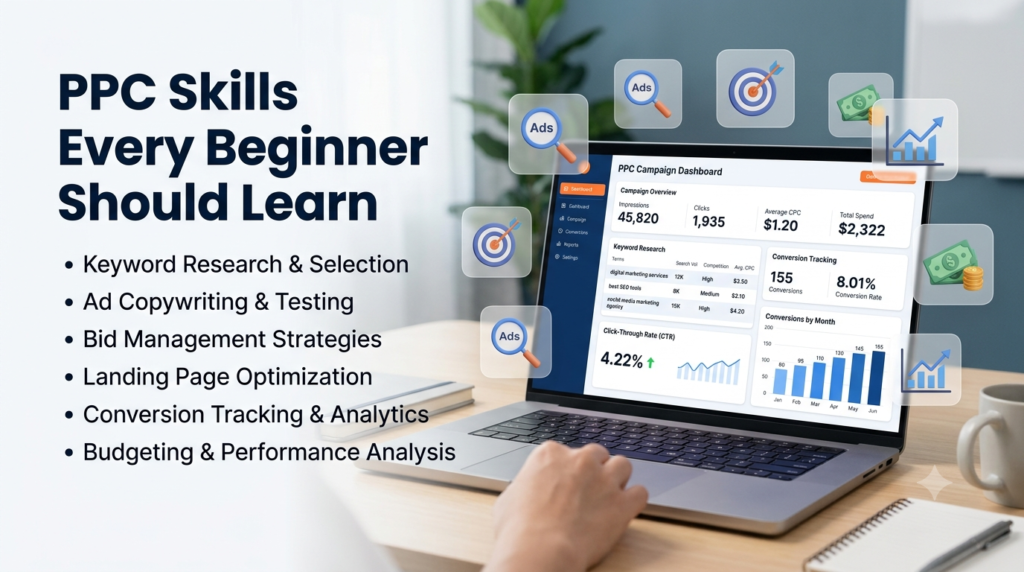
Pay-per-click advertising is an important part of digital marketing, helping businesses reach potential customers through search engines, display advertisements, and social media platforms. Learning PPC Skills Every Beginner Should Learn helps aspiring digital marketers understand how to create effective campaigns, attract relevant audiences, and achieve marketing goals. Essential skills include keyword research, ad copywriting, audience targeting, budget management, bidding strategies, and conversion tracking.
Platforms such as Google Ads and Microsoft Advertising allow businesses to promote their products and services to interested users. However, successful PPC advertising requires more than launching advertisements. Beginners must analyse campaign performance, understand customer behaviour, and optimise campaigns using reliable data. They should also learn how landing pages influence conversions and how advertising costs affect business results.
Developing these skills through structured learning and practical projects can help beginners build confidence, create a professional portfolio, and prepare for entry-level PPC and digital marketing roles.
What PPC Skills Should Every Beginner Learn to Start a Digital Marketing Career?
Beginners should start by understanding the fundamentals of pay-per-click advertising and how paid campaigns support business objectives. These PPC skills every beginner should learn include keyword research, campaign planning, ad creation, budget management, audience targeting, and performance analysis. Each skill contributes to a different part of the advertising process, from attracting potential customers to measuring whether an advertisement generates valuable results.
Learning these fundamentals also helps beginners understand how PPC fits into a broader digital marketing strategy. Paid advertising can complement search engine optimisation, content marketing, email marketing, and conversion rate optimisation. For example, a business may use SEO to attract organic visitors while running Google Ads to reach users searching for high-intent keywords. Understanding this relationship helps beginners create campaigns that support realistic business goals instead of focusing only on website traffic.
Essential PPC skills for beginners
- Campaign Planning: Define campaign objectives, identify target customers, and select suitable advertising channels. Set measurable goals that align spending with lead generation, sales, or brand awareness.
- Keyword Research: Identify search terms that potential customers use to find products or services. Evaluate search intent, relevance, competition, and estimated costs before selecting keywords.
- Ad Copywriting: Write clear headlines, persuasive descriptions, and relevant calls to action. Highlight customer benefits and encourage the right audience to take the next step.
- Budget Management: Understand daily budgets, bidding strategies, and average cost per click. Control advertising expenditure while collecting enough data to evaluate campaign performance.
- Performance Analysis: Interpret impressions, clicks, click-through rate, conversions, and cost per conversion. Use these metrics to identify successful campaigns and areas that need improvement.
- Campaign Optimisation: Review campaign performance regularly and make data-driven adjustments. Refine keywords, improve advertisements, adjust bids, and optimise landing pages to improve results.
How Can Beginners Learn Keyword Research for PPC Advertising?
Keyword research is one of the most important PPC skills every beginner should learn because search terms influence when advertisements appear and which users see them. Advertisers need to identify the phrases potential customers enter into search engines and understand the purpose behind those searches. A person searching for general information may have different intentions from someone looking for pricing, product comparisons, or a service provider. Matching keywords with the right audience intent helps make advertising more relevant.
Beginners can practise keyword research using tools such as Google Keyword Planner and other keyword research platforms. They should examine keyword relevance, estimated search volume, competition, and potential advertising costs when available. Search volume alone should not determine whether a keyword belongs in a campaign. A highly relevant phrase with strong purchase intent may provide greater business value than a broad keyword that attracts many visitors who are unlikely to convert.
Important keyword research techniques
- Identify Search Intent: Determine whether users are seeking information, comparing options, or ready to purchase. Choose keywords that match the campaign goal and landing-page content.
- Explore Long-Tail Keywords: Research specific phrases related to products, services, locations, or customer needs. These keywords can attract more relevant audiences, even when search volume is lower.
- Use Keyword Research Tools: Use Google Keyword Planner to discover related search terms and review available estimates. Select keywords that match the business offerings and advertising objectives.
- Organise Keyword Themes: Group related keywords into focused ad groups. This helps create relevant advertisements and direct users to suitable landing pages.
- Understand Match Types: Learn how broad, phrase, and exact match affect keyword targeting. Review search-term reports regularly to understand which searches trigger advertisements.
- Add Negative Keywords: Identify irrelevant search terms and exclude them when appropriate. This helps reduce wasted spending on clicks from users unlikely to convert.
What Google Ads Skills Are Important for PPC Beginners?
Google Ads is a major platform for search advertising and offers campaign formats designed for different marketing objectives. Beginners should learn how to navigate the interface, select campaign types, organise ad groups, choose targeting settings, and configure budgets. Understanding the structure of an advertising account makes it easier to manage campaigns systematically and identify where changes need to be made. These Google Ads skills also provide a foundation for exploring other paid advertising platforms.
Practical knowledge matters more than simply memorising platform terminology. Beginners should learn how campaign settings affect advertising delivery and how to review the results of their decisions. For example, selecting a relevant location, language, and schedule can help an advertiser reach suitable customers. Learning to check campaign status, policy notifications, keyword eligibility, and budget usage also helps prevent avoidable problems during campaign management.
Core Google Ads capabilities
- Account Structure: Understand how accounts, campaigns, ad groups, advertisements, and keywords are organised. A clear structure simplifies campaign management, reporting, and optimisation.
- Campaign Selection: Learn about Search, Display, Shopping, and Video campaigns. Choose the appropriate format based on business goals, target audiences, and advertised products or services.
- Targeting Settings: Practise setting locations, languages, audiences, devices, and schedules where available. These settings help reach relevant users and avoid unnecessary advertising expenditure.
- Bidding Strategies: Understand manual bidding and automated options such as Maximise Clicks and Maximise Conversions. Select strategies according to campaign objectives and available conversion data.
- Ad Assets: Learn to use sitelinks, callouts, images, and business information where appropriate. These assets can provide additional details and improve eligible advertisements.
- Policy Compliance: Understand Google Ads policies concerning claims, landing pages, products, and services. Following these rules helps prevent advertisement disapproval and campaign interruptions.
How Can Beginners Develop PPC Ad Copywriting and Creative Skills?
Ad copywriting is another essential area among the PPC skills every beginner should learn. Even when an advertisement reaches the right audience, its message must explain why the offer is relevant. Strong copy communicates a clear benefit, addresses a customer need, and provides an appropriate next step. For search advertisements, this often means combining relevant search terms with compelling headlines, informative descriptions, and clear calls to action.
Creative skills are also important for display, video, and social media campaigns. Beginners should understand how visuals, headlines, formats, and messages work together to attract attention without misleading users. Advertisements should make accurate promises and match the experience offered on the landing page. Testing different messages can reveal which benefits, offers, or calls to action resonate with the target audience.
Best practices for writing effective PPC advertisements
- Write Relevant Headlines: Use language that matches the user’s search intent and clearly communicates the offer. Avoid exaggerated claims that the business cannot support.
- Highlight Customer Benefits: Explain how the product or service solves a genuine customer problem. Focus on practical benefits, such as saving time, reducing effort, or finding the right solution.
- Create Clear Calls to Action: Encourage users to take a specific step, such as requesting a quote or booking a consultation. Ensure the call to action matches the campaign goal and landing page.
- Maintain Message Consistency: Keep the advertisement, offer, and landing page aligned with the same message. Consistency helps visitors understand the offer and supports better conversion opportunities.
- Test Different Variations: Compare headlines, descriptions, images, and offers where testing is available. Use performance data to identify which variations deliver better results.
- Follow Advertising Policies: Avoid misleading claims, unsupported guarantees, and prohibited content. Accurate advertisements build customer trust and help prevent policy-related campaign issues.
Why Are PPC Budget Management and Bidding Skills Important for Beginners?
Budget management helps advertisers control spending while working towards defined marketing objectives. Beginners must understand the relationship between daily budgets, bids, competition, and advertising costs. A campaign may receive many clicks but still fail to produce valuable enquiries or sales. Therefore, successful PPC management requires balancing expenditure against the quality of traffic and the results generated by that traffic.
Bidding strategies influence how advertising platforms compete for eligible placements. Manual bidding can provide more direct control in suitable situations, while automated bidding uses platform signals and available data to optimise towards selected goals. Beginners should understand the purpose and limitations of each approach before choosing one. They should also avoid making frequent, unnecessary changes because these can make it harder to interpret performance trends and evaluate the impact of individual adjustments.
Budgeting and bidding skills to practise
- Set Realistic Budgets: Set a budget based on campaign objectives, available resources, and expected advertising costs. Start with a controlled amount that allows testing without creating unnecessary financial risk.
- Understand Cost Per Click: Cost per click (CPC) measures how much you pay for an individual advertising click. Evaluate CPC alongside traffic quality and conversions rather than focusing only on cheaper clicks.
- Learn Cost Per Acquisition: Cost per acquisition (CPA) measures the advertising cost of acquiring a conversion or customer. Compare CPA with profit margins and customer value to assess campaign sustainability.
- Choose Suitable Bidding Strategies: Select bidding strategies that match campaign goals and conversion tracking quality. Automated bidding works best when it has reliable data and enough time to learn.
- Monitor Budget Delivery: Review campaign spending, budget usage, and performance reports regularly. Investigate unusual changes before increasing budgets or making major bidding adjustments.
- Evaluate Return on Ad Spend: Return on ad spend (ROAS) compares revenue attributed to advertisements with advertising costs. Consider profit margins and other business expenses before deciding whether a campaign is profitable.
How Do PPC Beginners Learn Conversion Tracking and Campaign Analytics?
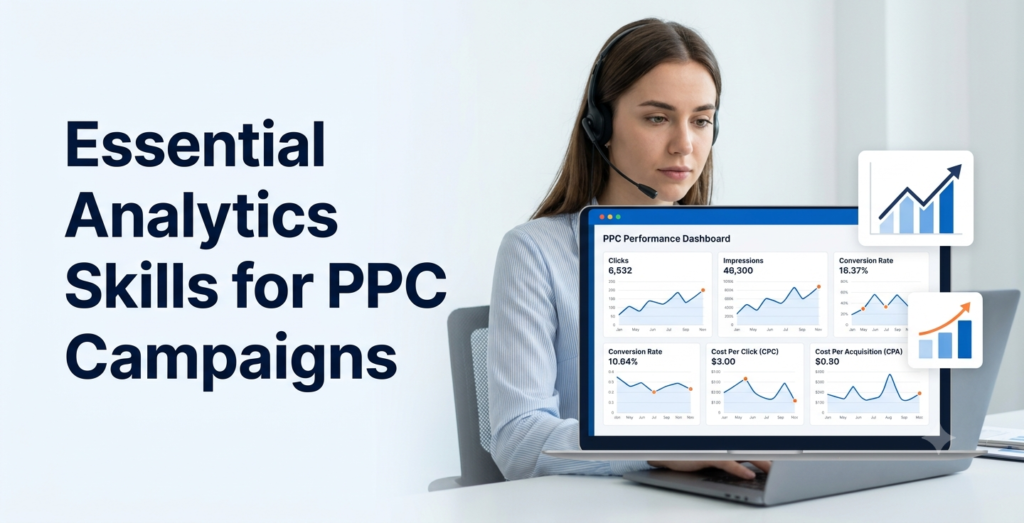
Conversion tracking and analytics help advertisers understand whether their campaigns generate useful business outcomes. A click indicates that someone interacted with an advertisement, but it does not confirm that the visitor completed a purchase, submitted a form, or called a business. Beginners should learn how to define meaningful conversions and measure the actions that matter to the organisation. This makes performance evaluation more useful than relying on clicks and impressions alone.
Tools such as Google Ads conversion tracking and Google Analytics can help businesses understand customer interactions when correctly configured. Beginners should learn the difference between advertising clicks, website sessions, leads, purchases, and other conversion events. They should also check whether tracking is recording the intended actions accurately and whether reports use consistent attribution settings. Incorrect or duplicated tracking can lead to misleading conclusions and poor optimisation decisions.
Essential analytics skills for PPC campaigns
- Understand Key Metrics: Learn impressions, clicks, click-through rate (CTR), CPC, conversions, conversion rate, and CPA. Understand what each metric measures and how it relates to campaign performance.
- Configure Conversion Actions: Identify valuable actions, such as purchases, qualified enquiries, or appointment bookings. Ensure each conversion action accurately tracks the intended user behaviour.
- Learn Google Analytics: Explore reports on traffic sources, landing-page behaviour, and user interactions. Use these insights to understand what visitors do after clicking an advertisement.
- Check Tracking Accuracy: Test conversion events to identify missing or duplicated measurements. Use available diagnostic tools and platform guidance to resolve tracking issues.
- Build Performance Reports: Create simple reports showing spending, clicks, conversions, CPA, and other relevant metrics. Clear reports help teams evaluate results and identify areas for improvement.
- Use Data for Decisions: Compare results over meaningful periods while considering changes in budgets, targeting, and campaign conditions. Avoid making major decisions based on small samples or short-term fluctuations.
What Landing Page and Audience Targeting Skills Should PPC Beginners Learn?
A successful PPC campaign depends on more than the advertisement itself. After clicking an ad, visitors need a landing page that provides relevant information and makes the intended action easy to complete. Beginners should understand how page relevance, loading speed, mobile usability, content clarity, and form design affect the user experience. A well-targeted advertisement can still waste money if its destination is confusing, slow, or unrelated to the advertised offer.
Audience targeting helps advertisers reach people based on relevant characteristics, interests, locations, or previous interactions, depending on the platform and campaign type. Beginners should learn how to select suitable targeting options without making audiences unnecessarily narrow. They must also understand privacy requirements and platform restrictions when using customer data. Effective audience targeting balances relevance, reach, user experience, and the campaign’s overall objective.
Landing page and targeting techniques
- Improve Landing Page Relevance: Match the page heading, offer, and content with the advertisement. Ensure visitors quickly find the information or solution promised in the ad.
- Optimise Mobile Experience: Check that pages display correctly on smartphones and that buttons, forms, and navigation work smoothly. A mobile-friendly experience helps visitors complete their intended actions.
- Simplify Conversion Actions: Remove unnecessary steps from enquiry forms and purchase processes. Use clear instructions and visible calls to action to make conversions easier.
- Understand Audience Segments: Learn how demographics, interests, search behaviour, and other available signals support audience targeting. Choose relevant options that align with campaign goals and platform policies.
- Use Remarketing Responsibly: Learn how to reach eligible previous website visitors or other permitted audiences. Follow privacy laws, consent requirements, and advertising platform policies when using remarketing.
- Evaluate User Experience: Review engagement and conversion data to identify possible landing-page issues. Test improvements systematically instead of assuming every problem comes from advertising settings.
How Can Beginners Practise PPC Skills and Prepare for Entry-Level Jobs?
Beginners can develop practical PPC skills every beginner should learn through structured learning, campaign simulations, supervised projects, and small controlled experiments. Reading about advertising concepts is useful, but applying them helps learners understand how campaign settings affect real outcomes. Start by selecting a sample business, defining its target audience, researching relevant keywords, and writing advertisements for a clear objective. A practice project can demonstrate planning and analytical ability even when the learner has limited access to live advertising accounts.
Career preparation should also include communication, reporting, and problem-solving. PPC professionals often need to explain campaign results, recommend budget changes, and collaborate with designers, content writers, and sales teams. Beginners can create sample campaign plans and mock performance reports to demonstrate their understanding without claiming results they have not achieved. Google Ads learning resources and relevant certifications can support this process, while internships and supervised projects provide opportunities to gain practical experience.
A practical learning plan for PPC beginners
- Learn the Fundamentals: Study search auctions, keywords, campaign structures, targeting, and bidding strategies. Create a glossary of essential PPC terms and practise explaining them simply.
- Complete Platform Training: Explore official Google Ads learning materials and other reliable training resources. Learn campaign setup, advertising policies, performance measurement, and optimisation.
- Create a Sample Campaign: Choose a hypothetical business and prepare a campaign brief, keyword list, sample ads, targeting settings, and budget. Present it clearly as a practice project, not a live campaign.
- Practise Data Analysis: Use sample or anonymised data to calculate CTR, conversion rate, CPC, and CPA. Write a short report explaining the results and suggesting improvements.
- Build a PPC Portfolio: Include campaign plans, keyword research, sample advertisements, landing-page recommendations, and mock reports. Clearly distinguish practice projects from actual client work.
- Apply for Entry-Level Roles: Search for PPC Intern, Google Ads Executive, Paid Media Assistant, and Junior PPC Executive positions. Highlight your analytical thinking, attention to detail, digital marketing knowledge, and willingness to learn.
Conclusion
Learning PPC skills every beginner should learn provides a practical starting point for building a career in paid digital advertising. Keyword research, Google Ads campaign management, ad copywriting, budget control, conversion tracking, analytics, audience targeting, and landing-page optimisation all contribute to more effective campaigns. These skills help advertisers understand customer needs, manage expenditure responsibly, and measure performance against business goals.
Beginners should focus on building a strong foundation before attempting advanced optimisation techniques. Start with structured training, practise campaign planning, learn to interpret performance metrics, and create a portfolio that demonstrates your understanding. As your experience grows, explore more advanced bidding strategies, experimentation, and cross-channel advertising. Consistent practice and evidence-based decisions can help you progress towards a PPC internship, junior advertising position, or broader digital marketing role.
Explore Our Recent Blog
- What Jobs Can You Get After a Social Media Course?
- Google Ads Course Syllabus for Beginners
- Is Digital Marketing a Good Career in 2026?
- Digital Marketing Tools Every Beginner Should Learn
- Practical Skills You Learn in a Digital Marketing Course
Frequently Asked Questions
1. What are the most important PPC skills for beginners?
The most important PPC skills include keyword research, campaign setup, ad copywriting, budget management, bidding, and performance analysis. Beginners should also learn conversion tracking and landing-page optimisation to understand how advertisements contribute to business results. Practising these skills through structured projects can help build confidence before managing live campaigns.
2. Is PPC difficult to learn for someone new to digital marketing?
PPC can be learned step by step, even without previous advertising experience. Beginners should first understand basic terminology, keyword targeting, campaign structure, and advertising budgets before exploring advanced bidding and analytics. Regular practice and careful evaluation of campaign data make the learning process more manageable.
3. Which tools should a beginner learn for PPC advertising?
Google Ads is a useful starting point for learning paid search advertising. Google Keyword Planner can support keyword research, while Google Analytics and suitable conversion-tracking tools help measure website activity and campaign outcomes. Beginners may explore Microsoft Advertising and other platforms after developing a strong foundation.
4. Do beginners need coding skills to work in PPC?
Most entry-level PPC roles do not require advanced coding skills. However, understanding basic website concepts, tracking tags, conversion events, and landing-page performance can be helpful. Technical support or developer assistance may be necessary when implementing complex tracking or resolving website issues.
5. How long does it take to learn PPC skills?
The time required depends on the learner’s experience, study schedule, and access to practical projects. A beginner may understand the fundamentals within a few weeks, but developing reliable campaign management and optimisation skills generally requires continued practice. Working with real campaign data under supervision can help learners develop stronger judgement.
6. Can beginners get a job after learning PPC advertising?
Yes, beginners can apply for internships and entry-level positions such as PPC Intern, Junior PPC Executive, or Paid Media Assistant. Employers may look for platform knowledge, analytical ability, communication skills, and an understanding of advertising objectives. A portfolio of honest practice projects, relevant training, and supervised experience can strengthen an application.
