
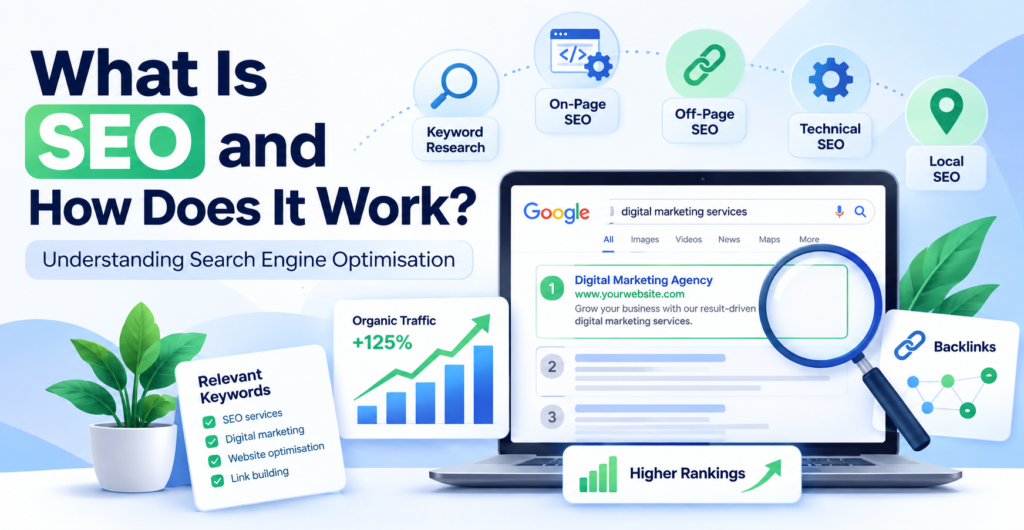
Search Engine Optimisation (SEO) is an essential part of digital marketing that helps businesses improve online visibility and attract potential customers. Understanding What Is SEO and How Does It Work? is important for business owners, digital marketers, content writers, and beginners who want to build a strong online presence. SEO involves several activities, including keyword research, on-page SEO, off-page SEO, technical SEO, content optimisation, and link building.
These techniques help search engines understand website content and determine its relevance to users’ search queries. By improving website structure, content quality, and user experience, businesses can attract organic traffic without paying for every click. A well-planned SEO strategy also helps build brand credibility, generate quality leads, and support long-term business growth. In this guide, we will explore how search engines work, different types of SEO, important ranking factors, and practical ways to improve website performance.
What Is SEO and Why Is It Important for Businesses?
SEO stands for Search Engine Optimisation. It is the process of improving a website to increase its visibility in organic, unpaid search engine results. When users enter a query into Google, search engines analyse millions of web pages to identify results that best match their search intent. SEO helps businesses make their websites easier to discover, understand, and navigate. It focuses on improving different website elements so that search engines can recognise the relevance and usefulness of their pages.
The importance of SEO goes beyond achieving higher Google rankings. It helps businesses connect with people who are already searching for related products, services, or information. For example, a person searching for “best digital marketing agency in India” may be interested in hiring a marketing service provider. If a relevant business website appears in the search results, it has an opportunity to attract that potential customer. This makes SEO an effective way to reach audiences who already have an interest in a particular topic or service.
Why Do Businesses Need SEO?
- Increases Organic Website Traffic: SEO helps websites appear for relevant search queries and attract visitors without paying for every click. Consistent organic traffic can create opportunities for businesses to generate leads and sales.
- Builds Brand Credibility: Websites that appear prominently in relevant search results can gain visibility and recognition. Helpful content, accurate information, and a professional website experience can strengthen user confidence.
- Generates Quality Leads: SEO targets users who are actively searching for specific products, services, or solutions. This allows businesses to attract visitors who may be more interested in their offerings.
- Improves User Experience: SEO encourages website owners to improve navigation, mobile usability, page speed, and content structure. These improvements make it easier for visitors to find the information they need.
- Supports Long-Term Growth: Unlike paid advertising, organic search traffic does not depend on paying for every website visit. Although SEO requires continuous investment and maintenance, strong rankings can generate traffic over time.
- Provides Measurable Results: Businesses can monitor organic clicks, impressions, keyword rankings, conversions, and other performance indicators. These insights help marketers understand what is working and where improvements are needed.
How Do Search Engines Work?
To understand how SEO works, it is important to understand how search engines discover, organise, and display website information. Search engines such as Google use automated programmes called crawlers or bots to discover web pages across the internet. These crawlers follow links, examine website content, and collect information about individual pages. The collected information is then processed and stored in a large database known as the search index.
Search engines generally perform three major activities: crawling, indexing, and ranking. Crawling helps search engines discover website pages, while indexing involves analysing and storing information about those pages. Ranking determines which indexed pages are most relevant and useful for a particular search query. These processes help Google provide users with relevant results when they search for information, products, or services.
What Are the Three Main Stages of Search Engine Processing?
- Crawling: Search engine bots discover web pages by following internal links, external links, sitemaps, and other available discovery methods. They collect information about page content, links, images, and website structure.
- Indexing: After discovering a page, search engines analyse its content, images, metadata, and relevant information. If a page meets indexing requirements, it may be stored in Google’s index and become eligible to appear in search results.
- Ranking: When someone enters a search query, Google’s systems identify relevant indexed pages and organise them according to numerous signals. These include relevance, content quality, usability, context, and other factors that help determine the most useful results.
Understanding Search Engine Ranking
Search engine ranking refers to the position a webpage receives in organic search results for a particular query. Google’s ranking systems consider many signals rather than relying on one single factor. For example, a page with relevant information, useful content, clear headings, and helpful links may be better positioned to satisfy a user’s search intent.
However, indexing does not guarantee ranking, and ranking does not remain permanent. Competitor content, changing search behaviour, website improvements, and search engine updates can influence search visibility. Therefore, businesses should regularly monitor their SEO performance and update their websites when necessary.
What Are the Different Types of SEO?
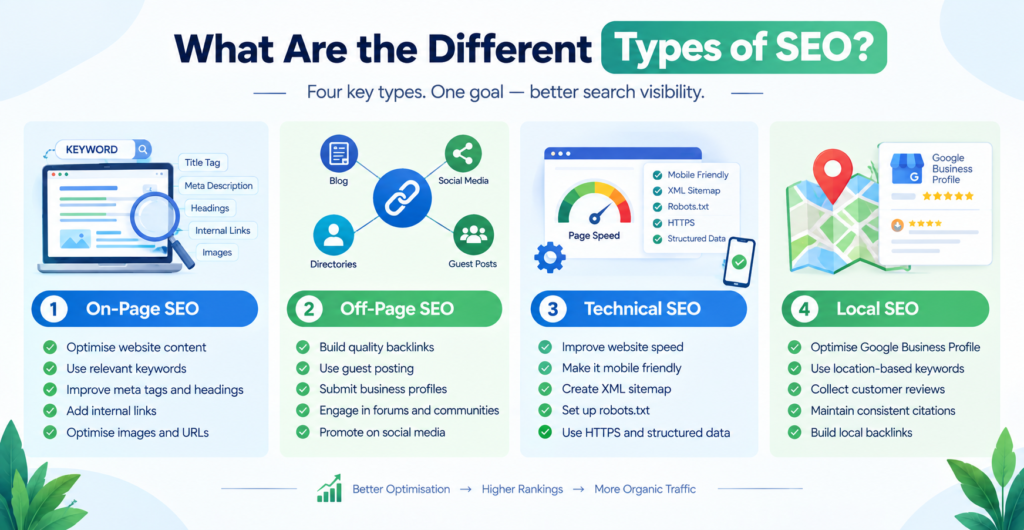
SEO includes several interconnected activities that improve different aspects of a website. Each type focuses on a specific area, but all of them contribute to a common objective: improving organic search visibility and providing a better experience for users. Understanding these categories helps digital marketers create a balanced SEO strategy instead of focusing only on keywords or backlinks.
The four major types of SEO are on-page SEO, off-page SEO, technical SEO, and local SEO. Each category has different techniques and objectives. For example, on-page SEO focuses on optimising website content, while off-page SEO involves building authority through external activities. Technical SEO improves the website’s technical foundation, and local SEO helps businesses reach customers searching for services in specific locations.
1. On-Page SEO
On-page SEO involves optimising individual website pages to make their content more relevant, understandable, and useful. It includes keyword placement, title tags, meta descriptions, heading structure, internal linking, image optimisation, and content quality. These elements help search engines understand the subject of a page while allowing visitors to find information easily.
Important on-page SEO activities include:
- Keyword Research and Placement: Identify relevant primary, secondary, and long-tail keywords. Include them naturally in important areas such as the title, introduction, headings, and body content.
- Meta Description: Create a useful summary that explains what visitors can expect from the page. Although meta descriptions are not a direct Google ranking factor, they can influence clicks from search results.
- Title Tag Optimisation: Write unique and descriptive title tags that explain the page topic. Include the primary keyword naturally and make the title relevant to the user’s search intent.
- Heading Structure: Organise content using H1, H2, and H3 headings. A clear heading hierarchy improves readability and helps users understand the relationship between different sections.
- Internal Linking: Link related pages within the same website to help users discover additional information. Internal links also help search engines understand website structure and find other pages.
- Image Optimisation: Use descriptive image file names, relevant alt text, and suitable image sizes. Proper image optimisation can improve accessibility and help search engines understand visual content.
2. Off-Page SEO
Off-page SEO includes activities performed outside a website to improve its reputation, authority, and visibility. One of its most recognised activities is link building, which involves earning backlinks from other relevant websites. When a trusted website links to your content, it can help search engines discover your pages and understand their importance within a particular topic or industry.
However, not every backlink provides value. Links from relevant, trustworthy websites are generally more useful than large numbers of unrelated or low-quality links. Off-page SEO should focus on building genuine relationships, publishing valuable resources, and earning natural references rather than manipulating search rankings.
Important off-page SEO activities include:
- Guest Posting: Publish informative articles on relevant third-party websites and earn appropriate references to your website. Guest posting should prioritise audience value and editorial quality.
- Business Profile Submissions: Create accurate business profiles on relevant directories and platforms. Maintain consistent business information to support brand discovery and local visibility.
- Classified Submissions: Publish relevant business advertisements on suitable classified platforms. Use genuine descriptions and avoid excessive or repetitive promotional submissions.
- Forum Participation: Participate in industry-related discussions by answering questions and sharing useful information. Avoid posting irrelevant links or promotional comments.
- Social Media Promotion: Share website articles, guides, and resources through social platforms. Social media engagement can increase content discovery and create opportunities to earn natural backlinks.
- Digital PR and Brand Mentions: Build relationships with publishers, journalists, and industry websites to earn genuine brand coverage. Relevant mentions can improve brand awareness and referral traffic.
3. Technical SEO
Technical SEO focuses on improving the technical foundation of a website so search engines can crawl, render, and index its pages effectively. It also supports a smooth browsing experience for visitors. Even well-written content may struggle to gain organic visibility if important pages cannot be accessed, the website has serious technical problems, or search engines cannot understand its structure.
Technical SEO includes website speed optimisation, mobile friendliness, XML sitemaps, robots.txt configuration, HTTPS security, canonical tags, structured data, and fixing broken links. Regular technical audits help identify problems that may affect crawling, indexing, and user experience.
Important technical SEO activities include:
- Website Speed Optimisation: Improve page loading performance by compressing images, reducing unnecessary scripts, and using efficient hosting. Faster pages can provide a better browsing experience.
- Mobile-Friendly Design: Ensure that website pages work properly on smartphones and tablets. Google primarily uses the mobile version of a website for indexing and ranking.
- XML Sitemap: Create and maintain an XML sitemap that lists important website URLs. Submit it through Google Search Console to help Google discover important pages.
- Robots.txt File: Use the robots.txt file to guide crawlers about which website areas they can access. Incorrect rules can unintentionally block important pages from crawling.
- HTTPS Security: Use an SSL/TLS certificate to secure communication between the website and visitors. HTTPS is also a lightweight Google ranking signal.
- Fix Broken Links and Errors: Identify broken internal links, incorrect redirects, and unnecessary 404 errors. Resolve issues that prevent users and search engines from accessing important content.
4. Local SEO
Local SEO helps businesses improve their visibility in location-based search results. It is particularly useful for businesses that serve customers within a specific geographical area, such as restaurants, clinics, educational institutions, and digital marketing agencies. For example, a person searching for “SEO agency in Kanpur” is likely looking for a service provider in or around that location.
Local search optimisation involves maintaining an accurate Google Business Profile, collecting genuine customer reviews, using location-based keywords, and ensuring consistent business information across relevant directories. These activities help search engines understand where a business operates and which local searches may be relevant to it.
Important local SEO activities include:
- Google Business Profile Optimisation: Add accurate business details, contact information, service categories, working hours, and relevant photographs. Keep the profile updated.
- Local Keyword Research: Identify search terms that include relevant city, neighbourhood, or service-area names. Use them naturally on appropriate website pages.
- Customer Reviews: Encourage genuine customers to share their experiences. Respond professionally to both positive and negative feedback.
- Local Citations: Maintain consistent business name, address, and phone number information across relevant directories and platforms.
- Location-Based Content: Create useful pages that explain your services and relevance to specific areas. Avoid creating multiple low-quality pages with only location names changed.
- Local Backlinks: Build relationships with relevant local organisations, publishers, and business communities. Relevant local references can strengthen business visibility.
How Does SEO Work Step by Step?
SEO works through a combination of research, optimisation, content development, authority building, and performance analysis. It is not a one-time activity where you add keywords to a website and immediately receive higher rankings. Instead, SEO requires a planned process that addresses the needs of both search engines and website visitors.
A successful SEO strategy begins with understanding the target audience and identifying the search terms they use. Marketers then analyse competitors, optimise website pages, publish helpful content, improve technical performance, and build relevant backlinks. Once these activities are implemented, performance is monitored through tools such as Google Search Console and Google Analytics to identify opportunities for improvement.
A Step-by-Step SEO Process
1. Understand Your Target Audience: Identify the people you want to reach, their interests, common problems, and search behaviour. This helps you create content that answers relevant questions and matches user expectations.
2. Perform Keyword Research: Find primary, secondary, and long-tail keywords related to your products, services, or topics. Evaluate search intent, keyword difficulty, competition, and potential traffic opportunities.
3. Analyse Competitors: Review websites that already rank for your target keywords. Study their content structure, headings, backlink profiles, and search intent to identify areas where your website can offer more value.
4. Optimise Website Pages: Improve title tags, meta descriptions, headings, URLs, images, and internal links. Ensure that each page has a clear purpose and provides useful information.
5. Create High-Quality Content: Publish original, accurate, and relevant content that addresses users’ questions. Organise information logically and update existing pages when details become outdated.
6. Improve Technical SEO: Check website speed, mobile usability, crawlability, indexing, security, and structured data. Resolve technical issues that may prevent search engines from accessing important pages.
7. Build Relevant Backlinks: Earn links from trustworthy and relevant websites through guest contributions, digital PR, useful resources, and genuine industry relationships.
8. Monitor and Improve Performance: Track impressions, clicks, rankings, organic traffic, and conversions. Use the collected data to identify weak pages, improve content, and refine your SEO strategy.
What Are the Best SEO Tools for Beginners?
SEO tools help digital marketers research keywords, analyse competitors, monitor website performance, identify technical issues, and evaluate backlinks. Beginners do not need to purchase every available SEO tool. Starting with a few reliable platforms is usually enough to understand the fundamentals and practise important optimisation activities.
Different SEO tools serve different purposes. Some provide direct information from Google, while others offer keyword databases, backlink analysis, website auditing, and competitor research features. Learning how to use these platforms can make SEO work more organised and data-driven.
Essential SEO Tools You Should Learn
- Google Search Console: This free Google platform helps website owners monitor search performance, impressions, clicks, indexing issues, and search queries. It is particularly useful for identifying pages that receive impressions but need better click-through performance.
- Google Analytics 4: GA4 helps measure website traffic, user interactions, engagement, and conversions. SEO professionals can use it to understand what visitors do after arriving through organic search.
- Google Keyword Planner: This tool helps identify keyword ideas and estimated search volumes. It is useful for discovering potential keywords for SEO content and paid advertising campaigns.
- Semrush: Semrush provides keyword research, competitor analysis, backlink analysis, position tracking, and site audit features. It helps SEO professionals understand website performance and discover optimisation opportunities.
- Ahrefs: Ahrefs offers backlink analysis, keyword research, competitor research, and content exploration features. It is particularly useful for studying backlink profiles and identifying link-building opportunities.
- Screaming Frog SEO Spider: This website crawler helps identify broken links, missing metadata, duplicate titles, redirects, and other technical SEO issues. It is useful when performing website audits.
What Are the Most Important SEO Ranking Factors?
Google uses automated ranking systems that consider numerous signals to determine which pages are most relevant and useful for a search query. There is no single formula that guarantees a top position. The importance of different signals can vary depending on the query, topic, and context in which someone searches.
SEO professionals should therefore focus on improving the overall quality and usefulness of a website instead of trying to manipulate individual ranking factors. Relevant content, a positive page experience, accessible website structure, and trustworthy information all contribute to a strong SEO foundation.
Key Factors That Influence Organic Search Performance
- Content Relevance and Quality: Content should directly address the topic and provide useful information. Original research, practical examples, accurate explanations, and clear answers can improve its value for readers.
- Search Intent: Understand whether users want information, want to compare options, intend to make a purchase, or are looking for a particular website. Content should match the purpose behind the search query.
- Backlink Quality: Relevant links from trustworthy websites can support a page’s authority and discovery. Focus on earning natural links instead of purchasing large numbers of low-quality backlinks.
- Mobile Usability: Websites should provide a consistent experience across mobile devices, tablets, and desktops. Visitors should be able to read content and navigate pages without difficulty.
- Page Experience: Avoid intrusive pop-ups, confusing navigation, and unnecessary layout problems. Core Web Vitals also help assess important aspects of loading performance, interactivity, and visual stability.
- Website Structure and Internal Links: Organise pages logically and connect related content through useful internal links. A clear structure helps visitors navigate the website and supports search engine discovery.
How Long Does SEO Take to Show Results?
SEO generally takes time because search engines need to discover, crawl, index, and evaluate website pages. The time required to notice improvements depends on several factors, including website age, competition, content quality, technical health, backlink profile, and the difficulty of target keywords. A newly launched website may need more time to build visibility than an established website with relevant content and existing authority.
In many cases, businesses may begin noticing early SEO improvements within three to six months, although this is not a guaranteed timeline. Competitive keywords and industries may require considerably longer. Some technical improvements can help search engines access pages sooner, while content updates may take time to influence rankings and organic traffic.
Factors That Affect SEO Results
- Website Age and History: Established websites may already have indexed pages, backlinks, and search visibility. New websites usually need time to build a strong online presence.
- Keyword Competition: Highly competitive keywords require stronger content, authority, and optimisation efforts. Less competitive long-tail keywords may offer earlier opportunities.
- Content Quality: Useful, accurate, and well-organised content can better satisfy search intent. Pages that provide limited information may struggle to compete with more comprehensive resources.
- Technical Website Health: Crawl errors, indexing problems, slow performance, and poor mobile usability can create obstacles. Fixing important technical issues can improve the website’s overall SEO foundation.
- Consistency of SEO Activities: Regular content updates, technical monitoring, and relevant link-building efforts help maintain and improve website quality.
- Competitor Performance: Search rankings are competitive. Other websites may publish better content, earn stronger backlinks, or improve their user experience, which can influence your position.
How Can You Learn SEO and Build a Career in Digital Marketing?
SEO is a valuable skill for people interested in digital marketing, content writing, website management, and online business development. Beginners can learn SEO through free educational resources, practical exercises, online courses, and hands-on website projects. Understanding the concepts is important, but applying them to real websites helps develop the skills needed for professional SEO work.
You do not need advanced technical knowledge to begin learning SEO. Start with keyword research, content optimisation, and basic website analysis. Gradually move towards off-page SEO, technical audits, competitor analysis, and performance reporting. Building a small portfolio of practical SEO projects can also help demonstrate your skills when applying for entry-level opportunities.
Practical Skills Required to Become an SEO Professional
- Keyword Research: Learn how to find relevant keywords using Google Keyword Planner, Semrush, and other research platforms. Understand search intent, search volume, keyword difficulty, and long-tail keywords.
- Content Optimisation: Practise writing SEO-friendly articles, improving headings, adding internal links, and creating relevant meta titles and descriptions. Focus on readability and useful information rather than keyword repetition.
- On-Page SEO: Understand title tags, H1 and H2 headings, URL structures, image alt text, internal linking, and content optimisation. Apply these techniques to sample website pages.
- Off-Page SEO: Learn how backlinks work and practise identifying relevant websites for genuine outreach. Understand guest posting, business listings, and other ethical link-building methods.
- Technical SEO: Learn the basics of crawling, indexing, XML sitemaps, robots.txt, canonical tags, redirects, and website performance. Practise identifying common website issues through SEO audit tools.
- SEO Reporting: Use Google Search Console and Google Analytics 4 to monitor website performance. Learn to prepare reports that explain organic traffic, clicks, impressions, keyword performance, and conversions.
Career Opportunities After Learning SEO
- SEO Executive: Works on keyword research, on-page optimisation, off-page activities, and website performance monitoring.
- SEO Content Writer: Creates informative, keyword-focused website content, blogs, landing pages, and articles that match search intent.
- Off-Page SEO Executive: Focuses on backlink acquisition, guest posting, outreach, business listings, and website authority-building activities.
- Technical SEO Executive: Identifies and resolves website crawling, indexing, speed, structured data, and technical performance issues.
- SEO Analyst: Studies keyword rankings, website traffic, competitor performance, and search visibility to recommend improvements.
- SEO Specialist: Develops and manages broader SEO strategies, coordinates optimisation activities, and works towards improving organic search performance.
Conclusion
Understanding What Is SEO and How Does It Work? is the first step towards building a strong digital presence and developing valuable digital marketing skills. SEO combines keyword research, on-page optimisation, off-page activities, technical improvements, and high-quality content to help websites become more visible in organic search results. Each activity contributes to making a website easier to discover, understand, and use.
For businesses, SEO offers an opportunity to attract relevant visitors, build brand credibility, generate leads, and support long-term growth. For beginners, it provides a practical career path with opportunities in content writing, SEO analysis, technical optimisation, and digital marketing. However, successful SEO requires patience, continuous learning, and regular performance analysis.
Start by learning the fundamentals, practising with SEO tools, and applying optimisation techniques to real or sample websites. As your experience grows, you will develop a better understanding of search engine behaviour and learn how to create strategies that deliver sustainable organic results.
Explore Our Recent Blog
- Google Ads Course Syllabus for Beginners
- Is Digital Marketing a Good Career in 2026?
- Digital Marketing Tools Every Beginner Should Learn
- Practical Skills You Learn in a Digital Marketing Course
- PPC Skills Every Beginner Should Learn
Frequently Asked Questions
1. What Is SEO in Simple Words?
SEO stands for Search Engine Optimisation. It is the process of improving a website so that it can appear more prominently in unpaid search engine results. It helps businesses attract relevant visitors from search engines such as Google without paying for every click.
2. How Does SEO Work for Beginners?
SEO works by helping search engines discover, understand, and evaluate website pages. Beginners can start by learning keyword research, on-page SEO, content optimisation, and basic technical SEO. They should also practise using Google Search Console and other SEO tools to understand website performance.
3. Is SEO Free or Paid?
Organic SEO does not require businesses to pay Google for every click or search result position. However, it may involve costs for SEO professionals, content creation, premium tools, website development, and technical improvements. Therefore, SEO is not necessarily cost-free, even though organic search traffic itself is unpaid.
4. What Are the Four Main Types of SEO?
The four main types of SEO are on-page SEO, off-page SEO, technical SEO, and local SEO. On-page SEO improves website content, off-page SEO builds external authority, technical SEO improves website infrastructure, and local SEO targets location-based searches. Together, these activities help businesses develop a balanced search engine optimisation strategy.
5. Can I Learn SEO Without Coding Knowledge?
Yes, you can learn the fundamentals of SEO without knowing how to code. Most beginner-level activities, such as keyword research, content optimisation, meta tag writing, and backlink analysis, do not require programming skills. However, learning basic HTML and technical website concepts can be helpful as you progress.
6. How Much Time Does It Take to Learn SEO?
The basic concepts of SEO can be understood within a few weeks through consistent learning and practice. However, developing professional skills in keyword research, technical SEO, content optimisation, and link building takes longer. Practical experience with real websites is essential for becoming confident in SEO work.
